

 DVB to QAM Transmodulator
 DVB to QAM Transmodulator
HDC-7004

Ordering Guide
BLANKOM HDC-7004
- HDC-7004: 4 × DVB-S/S2/S2X
- HDC-7004T: 4 × DVB-C/T/T2/ISDB-T
- HDC-7004A: 4 × ATSC
- Optional redundant power supply – please enquire
At a Glance
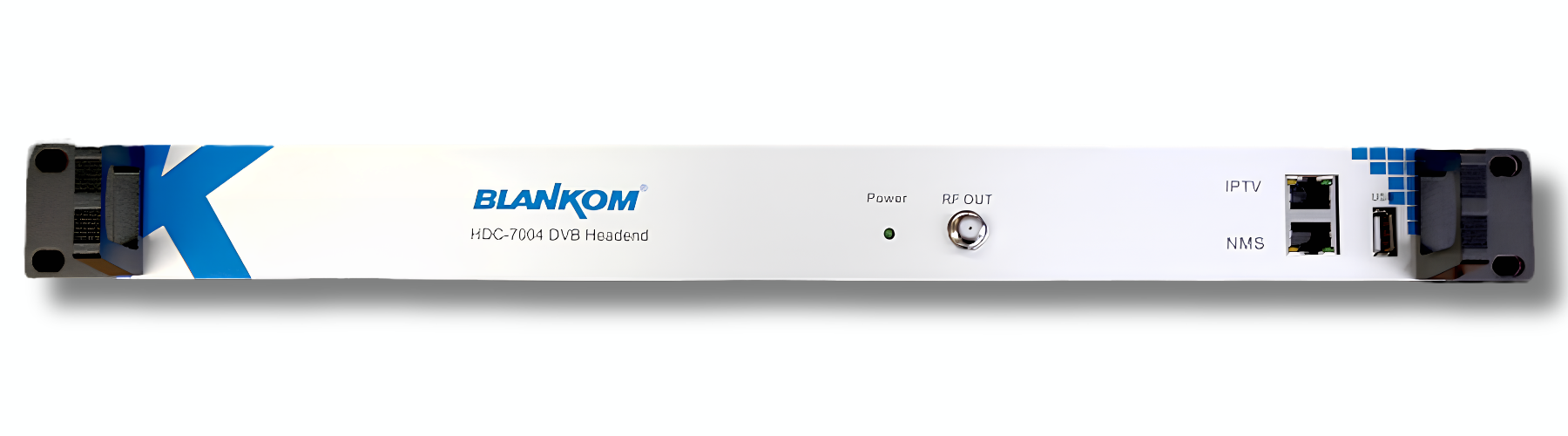
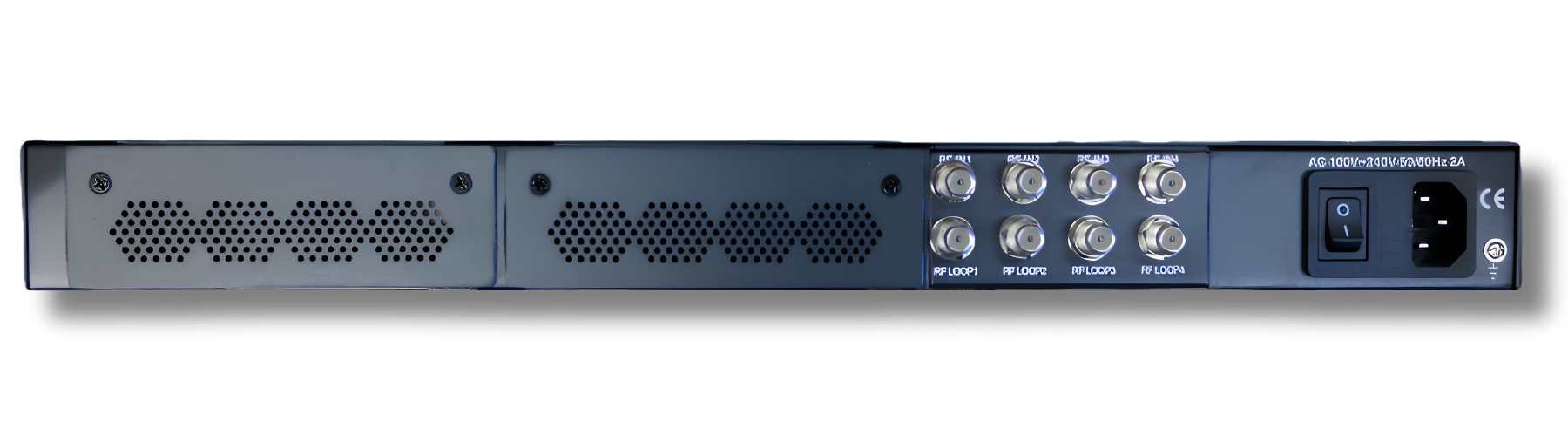
Front and Rear Panels
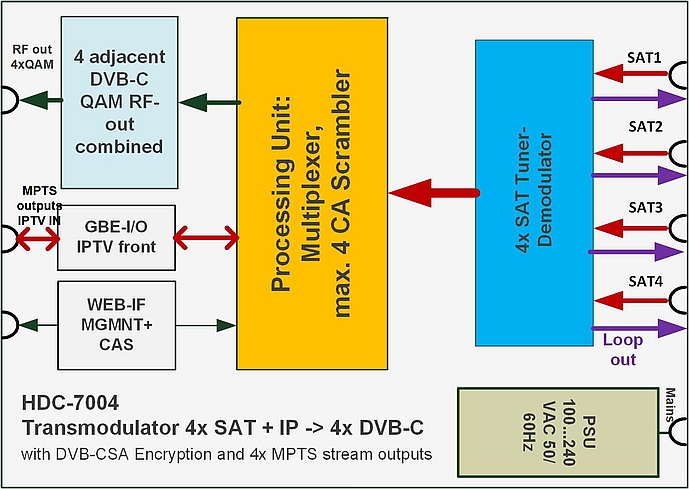
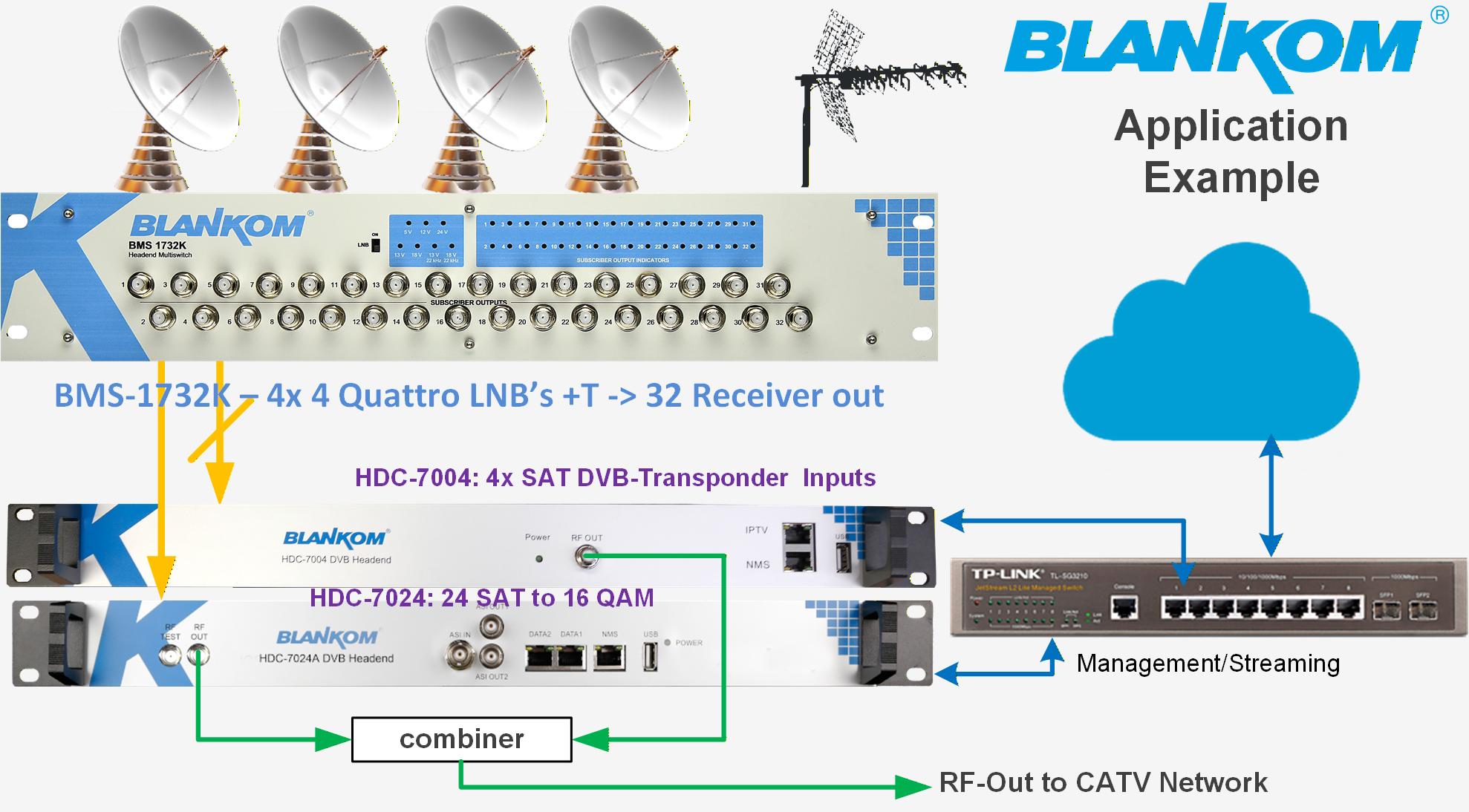
System Diagram
Technical Overview
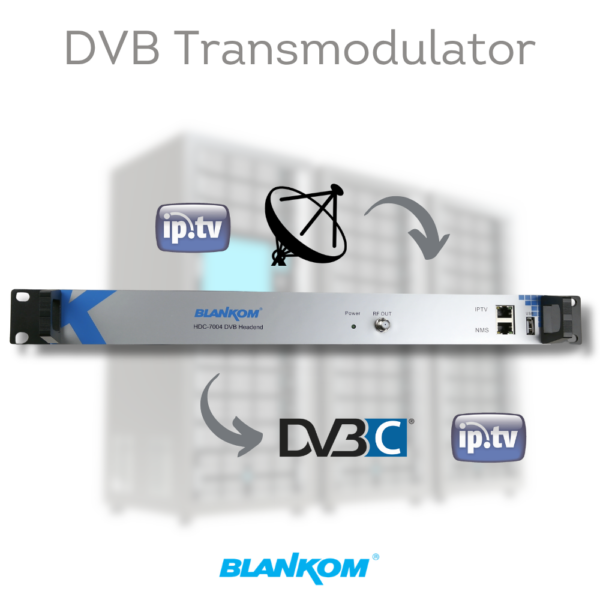
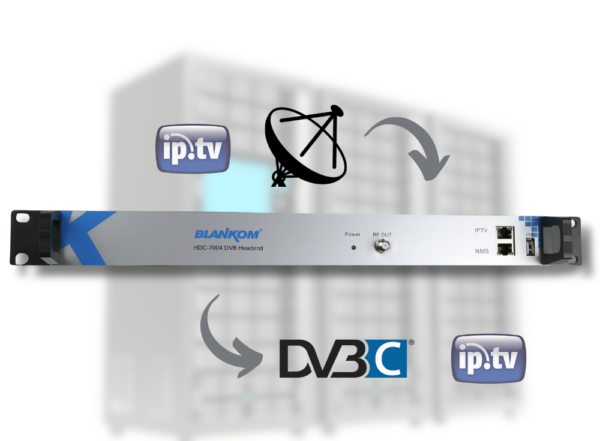
BLANKOM HDC-7004 combines four RF tuner inputs with IP reception, multiplexing, DVB-CSA scrambling and four adjacent DVB-C QAM carriers in a 1U headend. Programmes selected from the incoming transport streams are arranged into four output multiplexes. The same multiplexes are available as four MPTS IP outputs for a hybrid RF/IP installation.
The technical table specifies up to 512 IP inputs through Gigabit Ethernet, UDP/RTP unicast or multicast and IGMPv2/v3. Each IPTV input is limited to 84 Mbps as listed. PID remapping supports up to 512 PIDs per channel; PCR restamping and automatic PSI/SI generation prepare the output transport streams.
Four adjacent QAM carriers share one 75-ohm F-type RF output. The table specifies a 30–1000 MHz RF range, 5–9 MSps symbol rate and MER of at least 40 dB. Constellation and FEC depend on the selected DVB-C annex. Select the tuner variant, RF channel plan and external conditional-access configuration when ordering and commissioning.
Typical Applications
Hotel and campus cable-TV distribution
Receive satellite or compatible IP services and assemble four DVB-C multiplexes for an existing coaxial network. Plan adjacent RF frequencies, TV tuner compatibility and the available payload bitrate per carrier.
Regional CATV headend expansion
Combine selected services, remap conflicting PIDs and rebuild programme information before QAM modulation. Use the supported external CAS/Simulcrypt arrangement where scrambled output is required.
Parallel RF and IP delivery
Distribute the four programme multiplexes through DVB-C RF while feeding compatible downstream IP equipment with four MPTS. RF modulation does not change the video codec carried by the programmes.
Model Comparison
| Model | Configuration |
|---|---|
| HDC-7004 | Four DVB-S/S2 satellite tuner configuration. |
| HDC-7004T | Four DVB-C/T/T2/ISDB-T tuner configuration. |
| HDC-7004A | Four ATSC-T tuner configuration. |
Technical Specifications
INPUTS & PROCESSING
- 4 × DVB-S/S2/S2X satellite tuners
- HDC-7004T: DVB-C/T/T2/ISDB-T variant; HDC-7004A: ATSC variant
- SPTS/MPTS IP reception over UDP/RTP; unicast, multicast and IGMP v2/v3
- Gigabit Ethernet
- 4 integrated multiplexers for service selection and programme bouquet creation
- PID filtering/remapping, PCR adjustment and PSI/SI processing
- IP input-stream count and PID capacity: confirm the ordered revision
- Integrated DVB scrambling and up to 4 Simulcrypt CA systems with external CAS
- ETR289; ETSI 101 197 / 103 197
OUTPUT & MODULATION
- 4 adjacent DVB-C QAM carriers through one F-type, 75 Ω RF output
- Standard: DVB-C / EN 300 429; ITU-T J.83 A/B
- 16/32/64/128/256QAM, according to the DVB-C annex
- MER ≥40 dB
- 4 MPTS IP outputs over UDP/RTP, alongside RF distribution
- RF tuning range and symbol rate: confirm the supplied revision
INSTALLATION
- 19-inch, 1U chassis; 25.4 W consumption
- Dimensions: 430 × 220 × 44 mm (W × D × H); 3.5 kg
- Operation: 0…+45 °C; storage: −20…+80 °C
- AC 100 V ±10% / 220 V ±10%; 50/60 Hz
- NMS: 100Base-T; Web-based network management and firmware maintenance
- USB transport-stream playback
- Optional redundant power supply – please enquire
| IP inputs | 512 |
|---|---|
| IPTV input bitrate | 84 Mbps |
| PID capacity | 512 / channel |
| RF frequency | 30–1000 MHz |
| Symbol rate | 5–9 MSps |
| RF output level | −10…0 dBm / 87–107 dBµV |
IP stream count, PID capacity and RF tuning/symbol-rate limits vary between published revisions. Confirm the required limits and the ordered hardware/firmware configuration. Specifications are subject to change without prior notice.
Other BLANKOM Products

Engineering FAQ
What does HDC-7004 do to a programme stream?
It receives, selects, multiplexes and modulates services to DVB-C QAM. It does not need to decode video to baseband to perform this transport-stream workflow.
How many RF carriers are produced?
Four adjacent DVB-C QAM carriers share one 75-ohm F-type RF output. Include all four in the RF frequency and level plan.
What IP input capacity is specified?
The technical table lists up to 512 IP input streams through Gigabit Ethernet and a maximum 84 Mbps per IPTV input. Aggregate interface bandwidth also constrains the configuration.
Which transport and multicast protocols are listed?
TS over UDP/RTP with unicast and multicast is specified, together with IGMPv2/v3. Configure the headend network for the selected stream addresses.
What PID processing is available?
Up to 512 PIDs per channel, automatic/manual PID remapping, PCR restamping and automatic PSI/SI generation are listed.
Which RF frequency and symbol-rate ranges are specified?
The RF range is 30–1000 MHz in 1 kHz steps; symbol rate is 5–9 MSps in 1 kSps steps. Choose values supported by the receiving TVs.
Which QAM constellations can be selected?
16, 32, 64, 128 and 256QAM are listed, depending on the DVB-C annex. The constellation must be compatible with the network and receivers.
Can the output be used in both RF and IP systems?
Yes. Four MPTS IP outputs over UDP/RTP multicast accompany the four RF multiplexes. Match the downstream IP equipment to MPTS transport.
Does output scrambling require an external system?
The table lists DVB-CSA scrambling with up to four Simulcrypt CA systems and local/remote CAS connection. The corresponding CAS configuration and entitlements are part of the system.
How is the unit installed and managed?
It is a 19-inch 1U unit with Web/NMS management and USB upgrade support. Listed operating temperature is 0–45 °C and power consumption is 25.4 W.