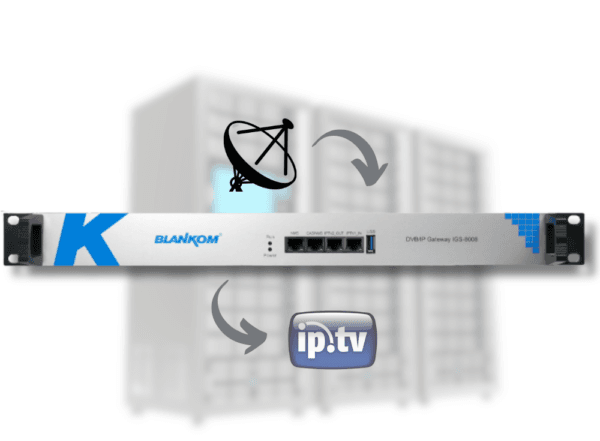
DVB to IP Streaming Gateway
IGS-8008


Ordering Guide
BLANKOM IGS-8008
- IGS-8008: 8 × DVB-S/S2/S2X
- IGS-8008C: 8 × DVB-C/T/T2/ISDB-Tb
- ATSC configuration: enquire
At a Glance
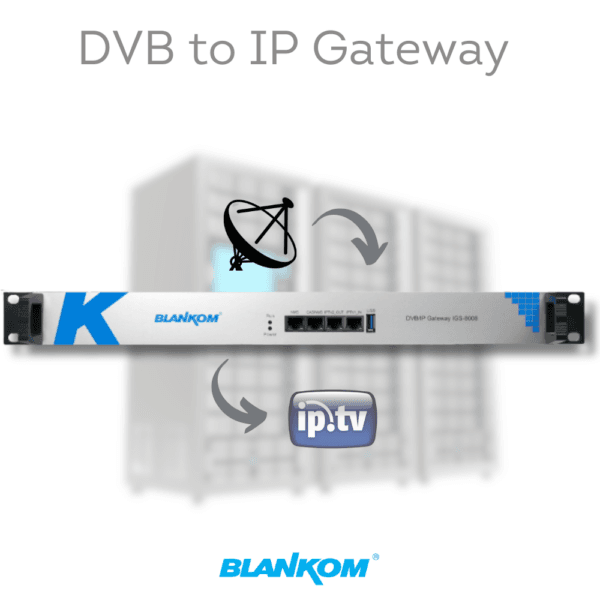
Front and Rear Panels

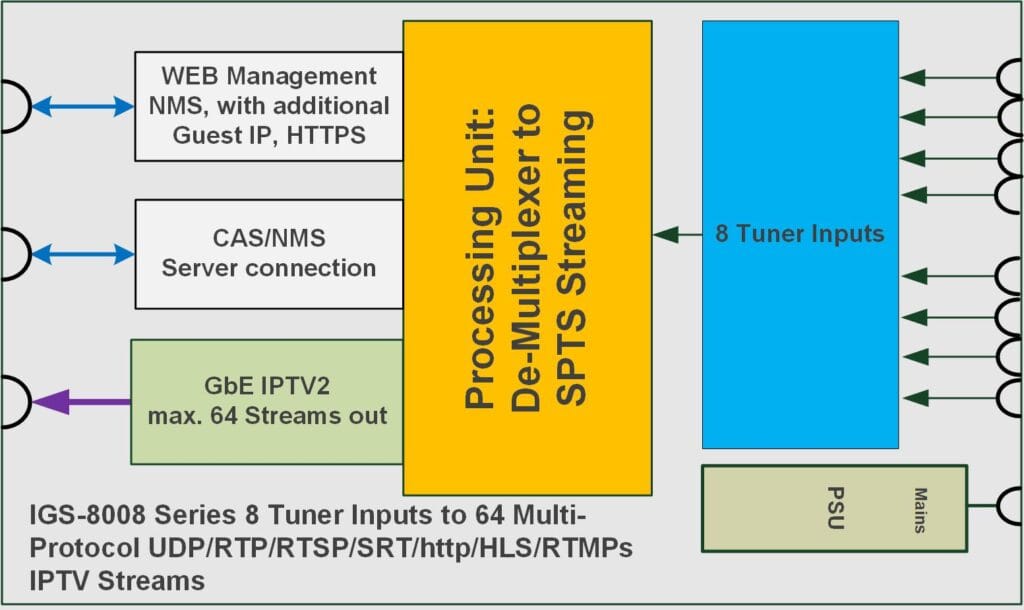
System Diagram
Technical Overview
BLANKOM IGS-8008 receives eight RF multiplexes and extracts selected TV or radio services as up to 64 SPTS. It is a DVB-to-IP gateway for transport-stream distribution. The receiving TVs, players or downstream equipment must support the source video/audio codecs; video transcoding is not specified for this model.
Choose IGS-8008 for DVB-S/S2/S2X satellite reception or IGS-8008C for DVB-C/T/T2/ISDB-Tb. V2 hardware includes RF loop-through outputs. Dynamic PMT follows changes in selected programme maps, while EIT demultiplexing carries the relevant programme-guide data with selected SPTS services to compatible receiving systems.
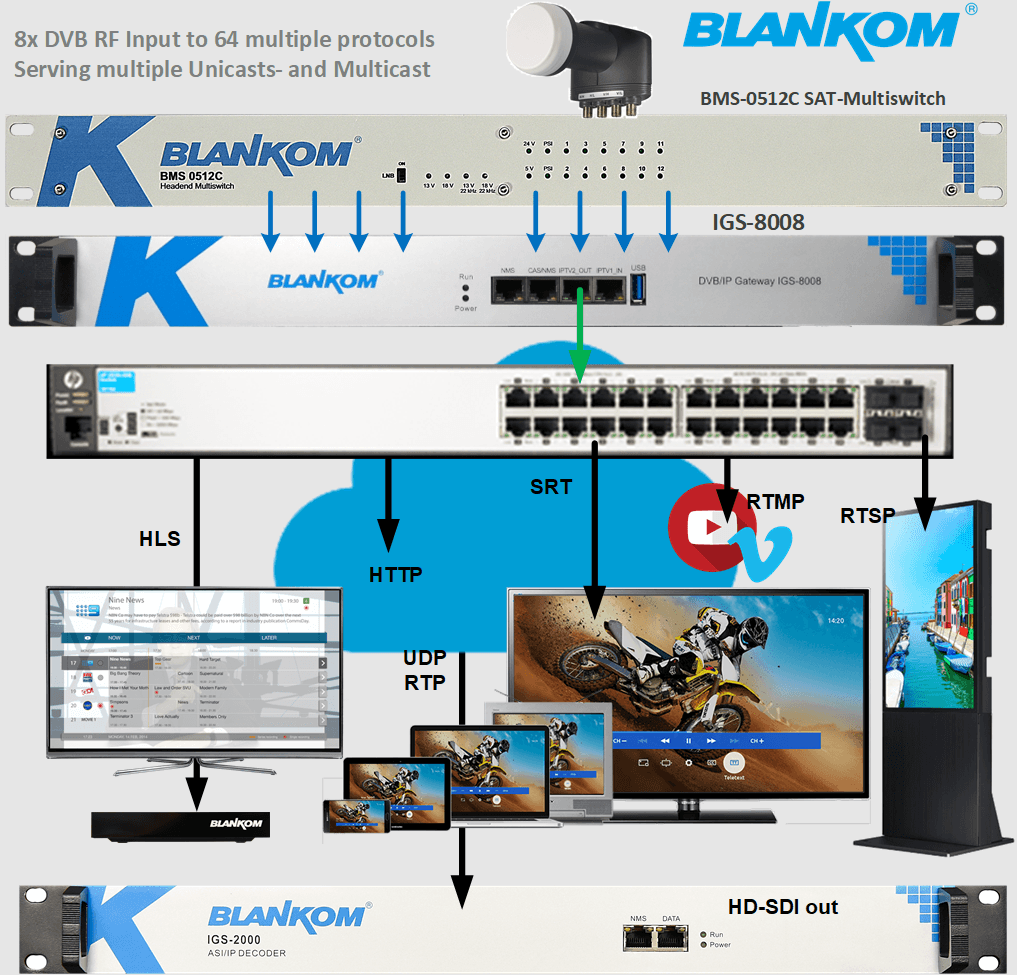
Streaming uses IPTV2 OUT with UDP, RTP, RTSP, RTMP, HTTP, HLS or SRT. The specified processing range is 100–400 Mbps, depending on protocol, aggregate bitrate and configuration; 64 SPTS is not a guarantee for every combination. HTTPS Web NMS provides configuration, firmware upgrades and remote reboot. The documented reserved IPTV1/USB connections should not be planned as extra working inputs.
Typical Applications
Hotel and campus linear IPTV
Receive broadcast multiplexes, select the required programmes and deliver compatible SPTS to the managed IPTV network. Match receiver codecs, multicast handling and the total output bitrate.
Programme-guide delivery with selected services
Use EIT demultiplexing with Dynamic PMT where receivers require programme-guide information alongside each selected SPTS. Verify guide display and programme-map changes with the actual receiving system.
Remote service distribution
Use the supported SRT or other streaming protocol to reach a compatible destination. Dimension the gateway and network for the selected protocol, number of services and aggregate bitrate; use a separate transcoder if the codec must change.
Model Comparison
| Model | Configuration |
|---|---|
| IGS-8008 | Eight DVB-S/S2/S2X satellite tuner inputs. |
| IGS-8008C | Eight DVB-C/T/T2/ISDB-Tb tuner inputs. |
Technical Specifications
INPUT / RF RECEPTION
- 8 × DVB-S/S2/S2X satellite tuner inputs
- IGS-8008C: separate DVB-C/T/T2/ISDB-Tb hardware variant; ATSC configuration on request
- 8 × F-type, 75 Ω
- IGS-8008: 950–2150 MHz
- QPSK / 8PSK / 16APSK: 0.5–45 MSps; 8APSK / 32APSK: 0.5–40 MSps
- IGS-8008C: 60–890 MHz; J.83 A/C: 16/32/64/128/256 QAM; J.83B: 64/256 QAM; 1–9 MSps
- DVB-T/T2: 5 / 6 / 7 / 8 MHz
- 8 RF loop-through outputs on V2 hardware
SERVICE PROCESSING
- Dynamic PMT and EIT demultiplexing
- Embedded BISS Mode 1 / Mode E; no CI/CAM slots
- PID filtering and up to 256 PID remappings
- PLS, DiSEqC and T2 multistream via satellite
- Automatic PSI/SI table generation
IP OUTPUT / MANAGEMENT
- Up to 64 SPTS through IPTV2 OUT; protocol-dependent
- UDP, RTP, RTSP, RTMP, HLS, HTTP and SRT
- 100–400 Mbps processing capacity, depending on protocol and configuration
- SRT: Caller / Listener / Rendezvous
- IPTV2 OUT: RJ45 Gigabit Ethernet; unicast / multicast
- NMS: RJ45, 100Base-T
- HTTPS Web NMS, web firmware updates and remote reboot
GENERAL
- 19-inch, 1U rack-mount chassis
- 482 × 367 × 44 mm (W × D × H)
- AC 110 V ±10% / 220 V ±10%; 50/60 Hz
- 0…+45 °C; storage: −20…+80 °C
Specifications are subject to change without prior notice. Confirm supplied hardware, firmware and PSU configuration.
Engineering FAQ
How many RF multiplexes can be received?
Eight RF inputs are specified. Select the satellite or cable/terrestrial hardware variant for the incoming broadcast standard.
Does 64 SPTS mean 64 streams in every configuration?
Up to 64 SPTS is specified. Usable capacity depends on protocol, aggregate bitrate and configuration.
What processing bitrate is specified?
The technical table gives 100–400 Mbps, depending on protocol and configuration. Plan the stream count and total bitrate together.
What does Dynamic PMT do?
It follows changes in incoming programme-map information for selected services. This supports continuity when service components or PID assignments change.
How is EPG information distributed?
EIT data is demultiplexed and carried with the selected SPTS. Compatible receivers must interpret that data; this is not a claim of generating a new programme guide.
Which streaming protocols are listed?
UDP, RTP, RTSP, RTMP, HTTP, HLS and SRT are specified. Select a protocol supported by the destination and size capacity accordingly.
Which SRT modes are supported?
Caller, Listener and Rendezvous are listed. Network addressing, firewall rules and the counterpart settings must match the selected mode.
Are CAM slots or BISS supported?
No CI/CAM slots are fitted. Embedded BISS Mode 1/Mode E is specified for authorised feeds with the appropriate configuration.
Can IPTV1 IN and USB be used as additional source inputs?
They are reserved in the documented configuration. Streaming uses IPTV2 OUT; do not count reserved connectors as extra working inputs.
Does the unit transcode and how is it managed?
Video transcoding is not specified. Use HTTPS Web NMS for configuration, upgrades and remote reboot; match source codecs to the receiving system.
BLANKOM DVB to IP, ASI to IP, IP to IP Gateways