

 Professional Dual Audio Encoder
 Professional Dual Audio Encoder
MPE-3000
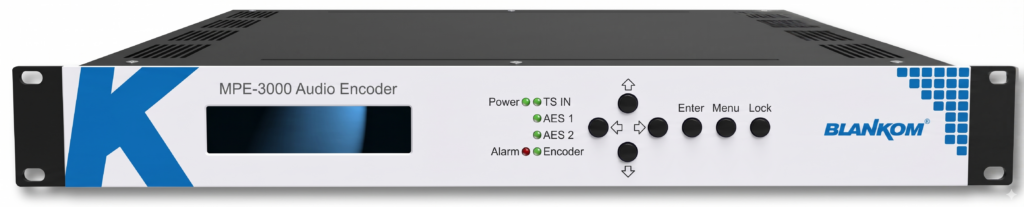
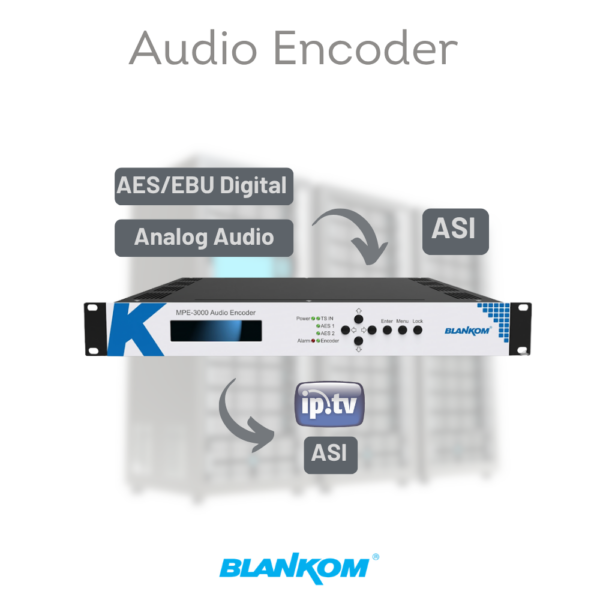
Manufacturer product page
Ordering Guide
- MPE-3000: dual audio encoder with single power supply
- Optional hot-pluggable redundant dual power supply
- Specify audio source, encoding format, bitrate and required output stream
At a Glance
Technical Overview
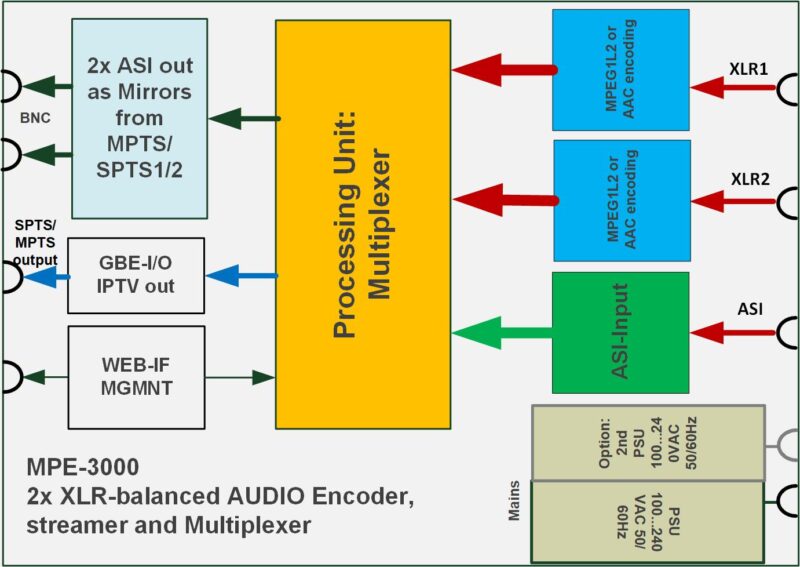
BLANKOM MPE-3000 converts two stereo audio programmes from balanced analogue XLR or digital AES/EBU sources into compressed audio transport streams. It is an encoder for the sending end of the signal chain; a compatible receiver or decoder is required at the destination. MPEG-1 Layer II and AAC are specified, with 48 kHz sampling and 16-bit sample accuracy.
The ASI input allows an existing transport stream to be multiplexed with the encoded audio. UDP/RTP delivery supports unicast and multicast through the 100/1000 Mbps Ethernet interface. The two BNC ASI connectors mirror the selected MPTS, SPTS1 or SPTS2 output; two physical connectors should not be interpreted as two separately configurable multiplexes.
Select the encoding bitrate and audio mode for the receiving system. Listed rates are 64, 96, 128, 192, 256, 320 and 384 kbps; AAC uses stereo mode. Configuration is available through the front-panel LCD/keypad or Web GUI. One power supply is standard and hot-pluggable redundant dual supplies are optional.
Typical Applications
Studio-to-transmitter audio
Feed the studio mixer into XLR or AES/EBU, encode the two stereo programmes and deliver compatible UDP/RTP streams to a decoder at the transmitter. Network capacity, receiver codec support and buffering must be planned for the complete link.
Central radio and branch distribution
Distribute a central programme through a managed multicast network to compatible branch receivers. Use unicast where the network design requires individual destinations; provision the network for the aggregate traffic.
Broadcast headend integration
Combine locally encoded audio with an existing ASI transport stream and feed the resulting ASI or IP output to downstream headend equipment. Match programme selection, PID allocation and receiver settings before commissioning.
Front and Rear Panels

System Diagram
Technical Specifications
| INPUT | Balanced analogue audio via XLR; Digital AES/EBU audio via XLR; 1 ASI input for multiplexing |
|---|---|
| OUTPUT | UDP/RTP IP output via 100/1000 Mbps RJ45, unicast/multicast; 2 ASI output interfaces (BNC); Mirrored output of the selected MPTS/SPTS1/SPTS2 transport stream |
| Chassis | 19-inch, 1U; 482 × 350 × 44 mm |
| Weight | Approximately 3.2 kg |
| Power consumption | <15 W |
| Power input | AC 110 V ±10% or 220 V ±10%, 50/60 Hz |
| Operating temperature | 0…+45 °C |
| Power supply | Single PSU standard; redundant dual PSU optional |
Specifications are subject to change without prior notice.
Engineering FAQ
How many audio programmes can MPE-3000 encode?
It provides two stereo audio encoding channels. Analogue and AES/EBU connectors are source-interface choices for this processing capacity, not additional encoding channels.
Which physical audio inputs are available?
Balanced analogue audio and digital AES/EBU are provided through XLR interfaces. Select the interface that matches the source equipment and audio routing.
Which audio codecs are specified?
The technical table specifies MPEG-1 Layer II and AAC. HE-AAC, linear PCM transport and other codec extensions are not established by that table.
Which sampling parameters are used?
The listed sampling rate is 48 kHz with 16-bit sample accuracy. Check the source format and destination decoder settings when integrating the signal chain.
Which encoding bitrates can be selected?
The specified choices are 64, 96, 128, 192, 256, 320 and 384 kbps. Select a value supported by the receiver and allow for transport overhead in network planning.
Does AAC support mono encoding?
The specified AAC mode is stereo only. Left, right and stereo soundtrack modes are listed for the encoder, with this AAC restriction.
What is the purpose of the ASI input?
One BNC ASI input accepts an existing transport stream for multiplexing. The multiplexing specification lists a maximum of 64 PIDs.
Are the two ASI outputs independent?
The two BNC output interfaces mirror the selected MPTS, SPTS1 or SPTS2 transport stream. They should not be specified as independently generated programme bouquets.
Which IP protocols and delivery modes are supported?
The output uses UDP/RTP over a 100/1000 Mbps RJ45 interface and supports unicast and multicast. Receiver compatibility and multicast routing remain part of the system design.
How is the unit managed and powered?
Use the built-in Web GUI or front-panel LCD and buttons. One PSU is standard; hot-pluggable redundant dual power supplies are an ordering option.