

 H.264 / MPEG-2 Broadcast Encoder
 H.264 / MPEG-2 Broadcast Encoder
MPE-4000
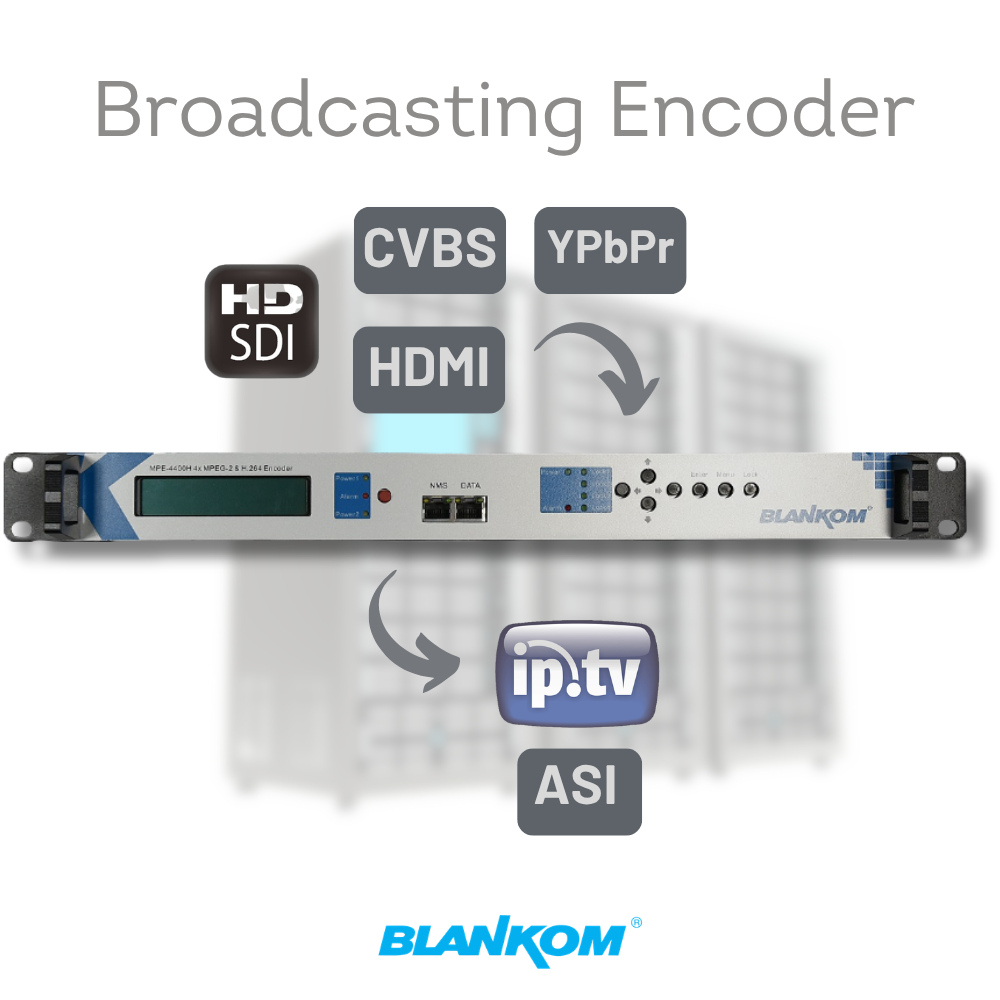
BLANKOM MPE-4000 combines two or four HDMI or SDI inputs, H.264/AVC and MPEG-2 HD/SD encoding, ASI remultiplexing and ASI/IP output. Choose the source count and interface required by the headend. Redundant power is available as an option for every variant. H.265/HEVC encoding is not supported.

Ordering Guide
- MPE-4200H: 2 HDMI inputs
- MPE-4200S: 2 SDI inputs
- MPE-4400H: 4 HDMI inputs
- MPE-4400S: 4 SDI inputs
- Select redundant power separately
- Specify codec, source resolution/frame rate, bitrate, audio configuration and ASI/IP stream allocation
Technical Overview
The MPE-4000 family converts local programme sources into transport streams for professional broadcast and IPTV distribution. MPE-4200 models accept two video sources; MPE-4400 models accept four. The H suffix identifies HDMI inputs and the S suffix identifies SDI inputs. These are alternative model configurations, so the required connector type must be specified when ordering.
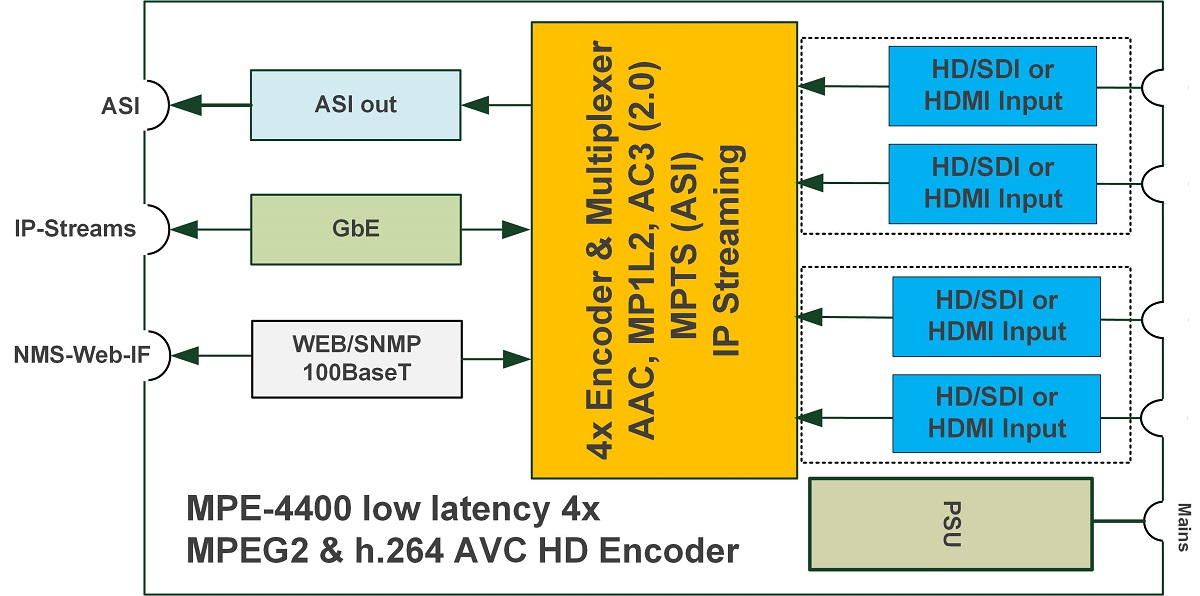
An additional ASI input feeds an existing transport stream into the internal multiplexer. Locally encoded programmes and the incoming ASI stream can be integrated with PSI/SI editing and insertion. The four-input platform provides one MPTS and four SPTS over Gigabit Ethernet. Its two BNC ASI connectors mirror the same selected MPTS or SPTS; they are not independent multiplex outputs. Confirm the required stream allocation for a two-input model.
The current V2 platform uses CBR encoding at 1–19.5 Mbps. H.264 supports 1920 × 1080p50/60; this progressive HD mode is not specified for MPEG-2. Other listed formats include 1080i50/60, 720p50/60 and SD. LCD/buttons and Web NMS support configuration, while the Normal, Mode 1, Mode 2 and Manual low-delay choices allow the encoder to be matched to the receiver workflow. No fixed end-to-end latency is specified.
At a Glance
INPUT
- MPE-4200H: 2 HDMI; MPE-4200S: 2 SDI
- MPE-4400H: 4 HDMI; MPE-4400S: 4 SDI
- 1 ASI input for remultiplexing
OUTPUT
- Four-input platform: 1 MPTS + 4 SPTS over IP
- UDP or RTP/RTSP; Gigabit Ethernet DATA interface
- 2 mirrored ASI output connectors; selected MPTS or SPTS
Key Features
- H.264/AVC and MPEG-2 HD/SD; no H.265/HEVC
- 1080p50/60 with H.264 only
- CBR video encoding, 1–19.5 Mbps on V2
- PSI/SI editing and insertion; IP null-packet filtering
- SDI versions: EIA-608, EIA-708 and Line 21 Closed Caption
- DD AC-3 encoding with −31 to −1 dB dialog normalization is specified; confirm the ordered audio configuration
- V2 SDI audio group/pair selection
- Drawer-type encoding modules; hot-swap is not specified
- Optional redundant PSU for all variants; web-based updates
Typical Applications
Broadcast and CATV headends
Encode local HDMI or SDI programme feeds and deliver ASI transport streams to a compatible downstream modulator. The MPE-4000 is the encoding and remultiplexing stage; RF delivery requires external modulation equipment. Choose MPEG-2 or H.264 according to receiver compatibility and the available multiplex bitrate.
Hotel, campus and corporate IPTV
Bring receiver outputs, cameras or information-channel sources into a managed IP distribution network. On the four-input platform, individual SPTS outputs can serve compatible IP receivers while an MPTS feeds headend equipment. Plan multicast support, switch capacity and receiver codec/resolution compatibility before commissioning.
Integrating an existing ASI bouquet
Use the ASI input to integrate an existing transport stream with locally encoded programmes. Configure service information and output allocation for the final multiplex. Size the combined service bitrate for the selected output path; the two ASI connectors remain mirrors of the same selected stream.
Camera and contribution workflows
Select the SDI version for a professional camera or production feed and use the available low-delay modes with a compatible decoder. Check the complete signal path, including codec, frame rate, receiver buffer and network behaviour. Request configuration-specific validation rather than assuming a fixed latency.
Model Comparison
| MPE-4200H | 2 HDMI; H.264 / MPEG-2; redundant PSU optional |
|---|---|
| MPE-4200S | 2 SDI; H.264 / MPEG-2; redundant PSU optional |
| MPE-4400H | 4 HDMI; H.264 / MPEG-2; redundant PSU optional |
| MPE-4400S | 4 SDI; H.264 / MPEG-2; redundant PSU optional |
Product Images
Panel photographs illustrate an MPE-4400H configuration. Connector layout depends on the ordered interface and hardware revision; use the supplied connector labels.

Technical Specifications
| Video codecs | H.264/AVC and MPEG-2 HD/SD |
|---|---|
| Video bitrate / control | 1–19.5 Mbps; CBR on V2 |
| H.264 progressive HD | 1920 × 1080p50/60; H.264 only |
| Other input formats | 1080i50/60; 720p50/60; 480i60; 576i50 |
| Chroma / aspect ratio | 4:2:0; 16:9 or 4:3 |
| ASI input | 1 input for remultiplexing |
| ASI output | 2 BNC mirror ports, selected MPTS or SPTS |
| IP output | Four-input platform: 1 MPTS + 4 SPTS, UDP or RTP/RTSP |
| DATA / NMS | 1000 Mbps RJ45 / separate 100 Mbps RJ45 |
| Audio | 48 kHz; 64/96/128/192/256/320 kbps; confirm ordered codec configuration |
| DD AC-3 | Encoding and dialog normalization −31 to −1 dB specified |
| Closed Caption | SDI models only: EIA-608, EIA-708 and Line 21 |
| Management | LCD/buttons; English Web NMS; web updates |
| Low-delay choices | Normal, Mode 1, Mode 2, Manual |
| Dimensions | 482 × 400 × 44 mm |
| AC input | 100–240 V AC |
| Power supply | Redundant power optional for all variants |
| Operating temperature | 0–45 °C |
Specifications are subject to change without prior notice.
Engineering FAQ
Does MPE-4000 encode H.265/HEVC?
No. The manufacturer specifies H.264/AVC and MPEG-2 for this family. The H.265 wording in the historical source URL does not describe the supported codecs.
How do I select between MPE-4200 and MPE-4400?
Choose MPE-4200 for two video inputs or MPE-4400 for four. Add H for HDMI or S for SDI. Specify the required audio and redundant power configuration with the model.
Is 1080p50/60 available with MPEG-2?
No. The current specification reserves 1920 × 1080p50/60 for H.264. MPEG-2 supports the listed interlaced HD, 720p and SD formats.
Are the two ASI outputs independent?
No. They are two BNC mirror connectors carrying the same selected transport stream, either an MPTS or an SPTS.
Can an existing ASI stream be combined with local sources?
Yes. One ASI input is provided for remultiplexing. Configure PSI/SI information and the output service allocation for the combined stream.
Does the current V2 platform offer VBR?
The current V2 specification states CBR at 1–19.5 Mbps. References to CBR/VBR describe the former version.
Is redundant power available on every model?
Yes, as an option for both two-input and four-input HDMI/SDI variants. It must be specified when ordering.
Which audio and Closed Caption details need confirmation?
The manufacturer specifies DD AC-3 encoding with dialog normalization and SDI audio group/pair selection on V2. Confirm the complete audio codec configuration. EIA-608, EIA-708 and Line 21 Closed Caption apply to SDI input versions only.
What information should accompany a quotation request?
Provide the input count and connector type, source format and frame rate, required codec and bitrate, audio format, ASI input content, IP/ASI output allocation, receiver details and power redundancy requirement.
Which low-delay modes are specified?
Normal, Mode 1, Mode 2 and Manual are listed. No fixed latency value is specified; evaluate the complete encoder, network and decoder path for the required application.