

 8-Carrier IP to DVB-T COFDM Modulator
 8-Carrier IP to DVB-T COFDM Modulator
HDC-5008T
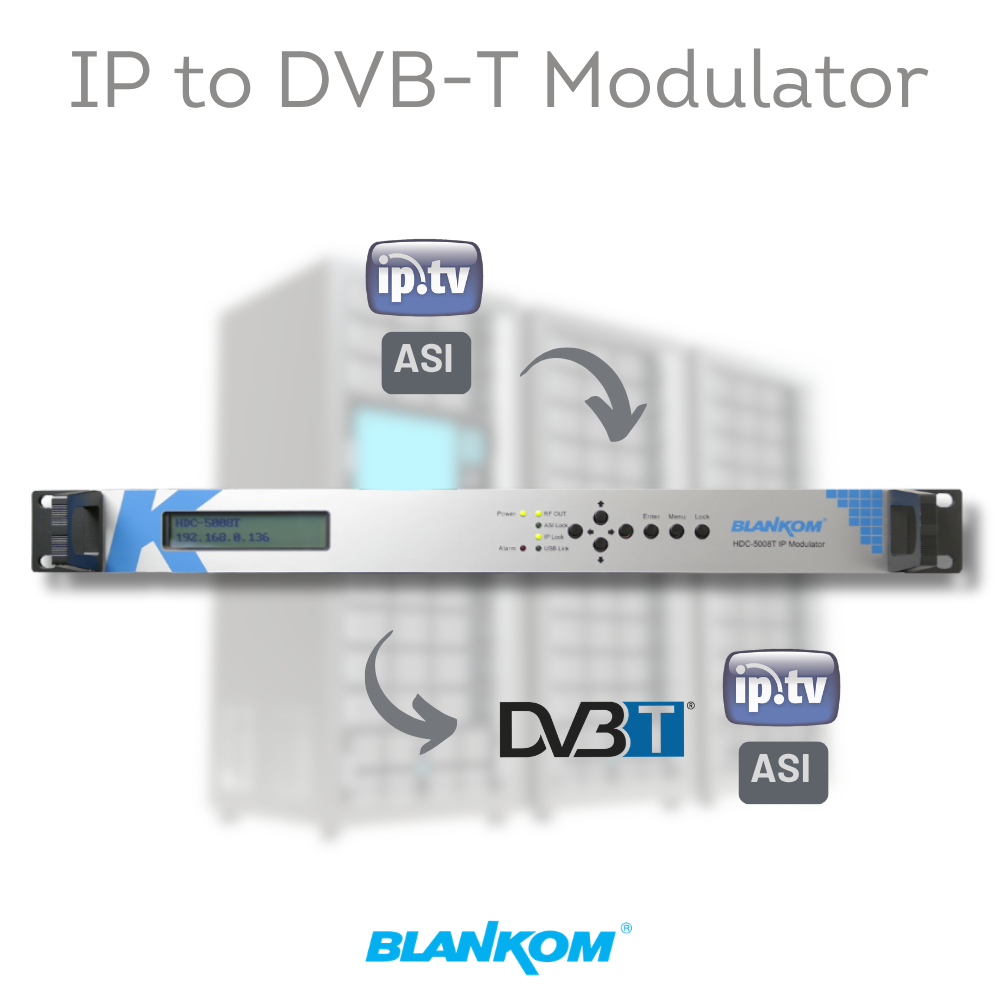
The BLANKOM HDC-5008T multiplexes IP and ASI transport streams into eight non-adjacent DVB-T COFDM carriers. It accepts a total of up to 512 IP inputs over four Gigabit data interfaces plus six ASI inputs. The 50–960 MHz RF output is accompanied by eight MPTS IP outputs and two ASI outputs mirroring the generated carriers. SFP interfaces are optional.

Ordering Guide
- HDC-5008T: IP/ASI modulator with eight DVB-T output carriers
- IP/ASI sources, service/PID plan and total input bitrate
- RF frequencies, bandwidth, FEC/modulation and output level
- Ethernet/SFP requirement, AC supply option and receiver codec support
Technical Overview
The HDC-5008T combines transport-stream selection, multiplexing and DVB-T RF modulation. IP/ASI services are assigned to eight output multiplexes, using PID remapping, PCR adjustment and PSI/SI processing. Video transcoding is a separate function; television receivers must support the original video and audio formats.
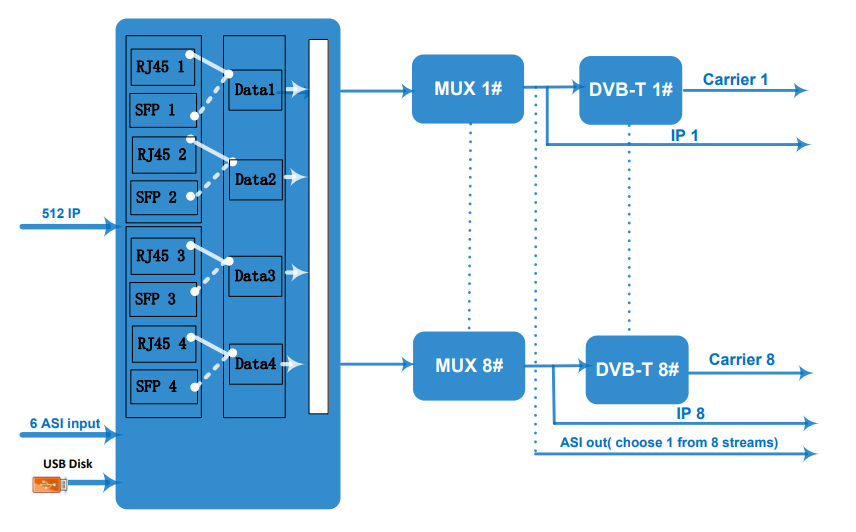
Data1 is bidirectional: it accepts IP inputs and delivers eight generated MPTS streams. Data2, Data3 and Data4 are input-only. The device limit is 512 IP inputs across the four ports, not 2048 inputs. The technical table specifies a maximum transmission rate of 840 Mbps per input interface.
COFDM settings include QPSK, 16QAM or 64QAM, 6/7/8 MHz bandwidth, 2K/4K/8K transmission modes and selectable FEC ratios. Programme capacity depends on the net capacity of the eight RF carriers and the service bitrates. Support for 512 IP inputs does not imply simultaneous RF carriage of 512 television programmes.
At a Glance
INPUT
- Total of up to 512 IP inputs over 4 × 100/1000 Mbps Ethernet data ports; optional SFP
- UDP/RTP transport streams; unicast/multicast; IGMP v2/v3
- 6 × BNC ASI inputs
OUTPUT
- 8 non-adjacent DVB-T COFDM carriers, 50–960 MHz
- 8 MPTS IP outputs on Data1 mirroring the RF carriers
- 2 ASI outputs, one as a mirror
Key Features
- Integrated multiplexer: eight output channels, up to 256 PIDs per channel
- Automatic/manual PID remapping; PCR adjustment; PSI/SI table generation
- ETSI EN 300 744; QPSK, 16QAM, 64QAM
- 6 / 7 / 8 MHz; 2K / 4K / 8K; FEC 1/2, 2/3, 3/4, 5/6, 7/8
- MER ≥40 dB; ACL −55 dBc
- 1 kHz RF frequency steps; 0.5 dB RF level steps
- Parallel IP MPTS and ASI delivery of generated carrier content
- Web-based network management
Application Examples
Hotel, hospital and campus coaxial distribution
Place central IP programmes into DVB-T multiplexes for distribution through a suitable existing coaxial network. Check the frequency plan, cable losses, distribution levels and television support for DVB-T and the source video/audio codecs.
DVB-T RF output from an IPTV headend
Assign UDP/RTP streams from gateways or encoders to eight output multiplexes. Calculate the net capacity of each multiplex and leave operating margin above the total service bitrate. Sources with unsuitable codecs require separate transcoding.
Combining IP and ASI sources
Organise six ASI inputs and IP services in the same multiplexer. Resolve PID conflicts and check service information and PCR behaviour when building output bouquets. Source count and RF payload capacity are different planning quantities.
Hybrid RF and IP distribution
The generated RF carrier content can also be delivered as eight MPTS IP streams to another distribution path. These are mirrors of the RF multiplexes, not additional independent bouquets. Verify MPTS support at the receiving gateway or endpoint.
Capacity and Output Planning
| IP source reception | Up to 512 IP inputs in total across four data ports; maximum 840 Mbps per input interface |
|---|---|
| RF distribution | 8 DVB-T COFDM carriers; net capacity depends on bandwidth, constellation and FEC |
| IP mirror | 8 MPTS on Data1, matching the RF carrier content |
| ASI mirror | 2 ASI outputs, one as a mirror; no additional RF carriers |
| Programme count | Calculate from service bitrates and selected RF capacity. 512 IP inputs do not guarantee 512 RF programmes. |
Product Images

Technical Specifications
| IP input | Data1–Data4; up to 512 total inputs; 100/1000 Mbps RJ45, optional SFP |
|---|---|
| Data port roles | Data1: input + 8 IP outputs; Data2–Data4: input only |
| ASI input | 6 × BNC |
| Input transport | TS over UDP/RTP; unicast/multicast; IGMP v2/v3 |
| Input interface transmission rate | Maximum 840 Mbps |
| Multiplexing | 512 input channels; 8 output channels; up to 256 PIDs per output channel |
| TS processing | PID remapping; PCR adjustment; automatic PSI/SI generation |
| DVB-T standard | ETSI EN 300 744 |
| Constellation / bandwidth | QPSK / 16QAM / 64QAM; 6 / 7 / 8 MHz |
| Transmission mode / FEC | 2K / 4K / 8K; 1/2, 2/3, 3/4, 5/6, 7/8 |
| RF output | 8 non-adjacent carriers; F-type connector |
| RF frequency | 50–960 MHz; 1 kHz steps |
| RF output level | −20 to +10 dBm for all carriers; 0.5 dB steps |
| RF quality | MER ≥40 dB; ACL −55 dBc |
| IP output | 8 MPTS; UDP/RTP/RTSP, unicast/multicast; Data1 100/1000 Mbps |
| ASI output | 2 outputs, one as a mirror |
| Management | Web-based network management |
| Dimensions | 430 × 180 × 44 mm |
| Temperature | Operation 0–45 °C; storage −20–80 °C |
| AC supply options | 100 V AC ±10% or 220 V AC ±10%; 50/60 Hz |
Specifications are subject to change without prior notice.
Technical FAQ
Is the HDC-5008T a video encoder or transcoder?
It multiplexes transport streams and performs DVB-T modulation. Codec conversion requires a separate verified transcoding function. Televisions and receivers must support the source video and audio formats.
How many DVB-T carriers are produced?
One device produces eight non-adjacent DVB-T carriers in the 50–960 MHz range. Programme capacity is calculated from the selected COFDM settings and service bitrates.
Are 512 IP inputs available per port or in total?
The specified device limit is 512 IP inputs in total. Data1–Data4 receive sources; multiplying the port count to assume 2048 inputs is incorrect.
Is SFP included as standard?
The technical table identifies SFP as optional. Specify the Ethernet/fibre interface configuration in the order.
How does Data1 differ from the other ports?
Data1 is bidirectional and provides eight MPTS IP outputs as well as input. Data2, Data3 and Data4 are dedicated to IP input.
Do IP and ASI outputs carry different programmes from RF?
The manufacturer describes IP and ASI outputs as mirrors of the generated carriers. Eight IP outputs represent the eight RF multiplexes as MPTS; additional independent bouquets must not be assumed.
Can any television receive the output?
The TV or external receiver must support DVB-T and the video/audio codecs of the source services. Check the coaxial network frequency range, signal levels and losses separately.
What information is needed for a quotation?
Provide IP/ASI sources, programmes and bitrates, PID/service plan, RF frequencies, bandwidth, FEC/constellation, output level, Ethernet/SFP and AC supply requirements.
Which DVB-T modulation parameters can be selected?
The technical table lists QPSK, 16QAM or 64QAM, 6/7/8 MHz bandwidth and 2K/4K/8K transmission modes. The receiving TVs must support the chosen DVB-T configuration.
How are programme identifiers and timing processed?
Up to 256 PIDs per channel, PID remapping, accurate PCR adjustment and automatic PSI/SI generation are specified. Configure these consistently with the programme bouquet and available carrier payload.