

 16-Channel CVBS/HDMI H.264 IP Encoder
 16-Channel CVBS/HDMI H.264 IP Encoder
ADE-16264
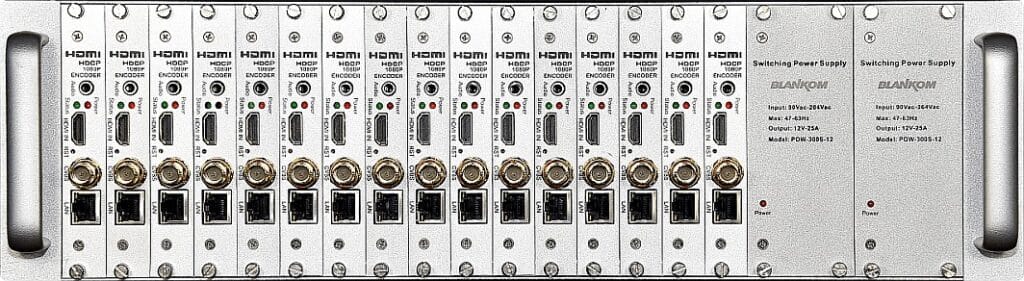
BLANKOM ADE-16264 integrates 16 CVBS/HDMI encoding channels in a 3U rack chassis with dual power supplies. It produces a main and a substream per channel using H.264 for IP distribution.
Ordering Guide
- Specify CVBS/HDMI allocation, PAL/NTSC or HDMI timing, analog audio paths and IP stream plan
Technical Overview
The unit is intended for aggregating analog composite and HDMI sources. CVBS accepts PAL/NTSC; HDMI supports HD formats. Composite video does not carry embedded audio, so the associated analog audio connection must be planned separately.
The specification defines two streams per channel: one main and one substream. The main stream reaches 1080p60 with a suitable HDMI source. H.264 and the listed protocols are the baseline; HEVC or SRT must not be assumed from other BLANKOM encoder models.
The 19-inch 3U enclosure consolidates multiple encoding channels and includes dual power supplies. Configure individual source and destination settings, then budget the active traffic on the actual Ethernet connections. Web management and logo/text overlays support daily operation.
At a Glance
INPUT
- Inputs: 16 CVBS/HDMI channels; CVBS PAL/NTSC
- Audio: HDMI embedded or separate analog audio; AAC family, MP3, MP2, AC-3, G.711; 12–640 kbps
OUTPUT
- Streams: 2 per channel: main + substream
- IP protocols: HTTP, HLS, FLV, RTSP, RTMP/RTMPS, UDP/RTP; ONVIF
FEATURES
- Video codec: H.264/AVC High/Main/Baseline
- Video rate: 0.1–32 Mbps; 5–60 fps; CBR/VBR
- Overlay: Logo and text on main and second stream
- Control: Web GUI; firmware upgrade; noise reduction and de-interlacing
Ordering Guide
- Ordering: Specify CVBS/HDMI allocation, PAL/NTSC or HDMI timing, analog audio paths and IP stream plan
Key Features
- Video codec: H.264/AVC High/Main/Baseline
- Video rate: 0.1–32 Mbps; 5–60 fps; CBR/VBR
- Overlay: Logo and text on main and second stream
- Control: Web GUI; firmware upgrade; noise reduction and de-interlacing
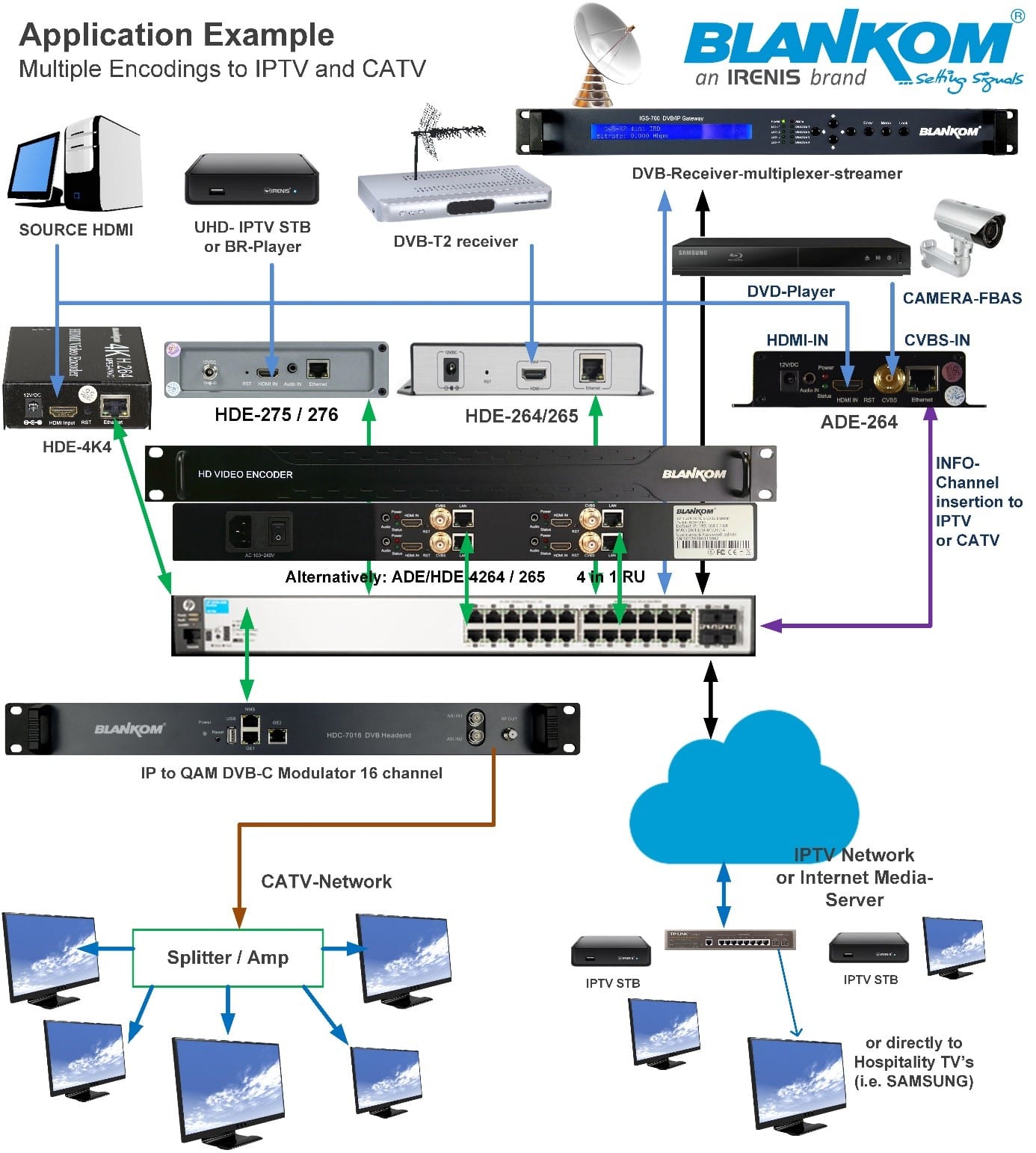
System Diagram
Manufacturer reference diagram. The complete topology and required accessories depend on the project.
Typical Applications
Analog source migration
Connect PAL/NTSC composite sources and their separate analog audio to the 16-channel rack. Encode H.264 for compatible IP receivers while preserving the source-format limits of CVBS.
Mixed SD and HD information channels
Bring existing CVBS equipment and HDMI information sources into one rack-based system. Configure each channel separately and calculate active stream rates on the specified 100 Mbps encoder interfaces.
Main and monitoring feeds
Use the two profiles per channel for a primary receiver and a secondary monitoring destination. Select a listed protocol; SRT and H.265 are not part of the confirmed ADE-16264 table.
Product Images
Family reference illustration; the depicted housing or model may differ from the selected variant.
Technical Specifications
| Parameter | Specification |
|---|---|
| Inputs | 16 CVBS/HDMI channels; CVBS PAL/NTSC |
| Video format | HDMI up to 1920 × 1080p60; CVBS according to PAL/NTSC |
| Streams | 2 per channel: main + substream |
| Video codec | H.264/AVC High/Main/Baseline |
| Video rate | 0.1–32 Mbps; 5–60 fps; CBR/VBR |
| IP protocols | HTTP, HLS, FLV, RTSP, RTMP/RTMPS, UDP/RTP; ONVIF |
| Ethernet | RJ45, 100 Mbps as specified for the encoder interface |
| Audio | HDMI embedded or separate analog audio; AAC family, MP3, MP2, AC-3, G.711; 12–640 kbps |
| Overlay | Logo and text on main and second stream |
| Control | Web GUI; firmware upgrade; noise reduction and de-interlacing |
| Rack chassis | 19-inch 3U; 483 × 300 × 133 mm; 6.5 kg |
| Power | Dual power supplies; published DC rating 12 V, 25 A |
| Ordering | Specify CVBS/HDMI allocation, PAL/NTSC or HDMI timing, analog audio paths and IP stream plan |
The listed values follow the official technical reference. Select the required model and configuration before ordering.
Technical FAQ
1. Which physical sources can be connected?
Inputs: 16 CVBS/HDMI channels; CVBS PAL/NTSC. Video format: HDMI up to 1920 × 1080p60; CVBS according to PAL/NTSC.
2. How many streams are provided per channel?
Streams: 2 per channel: main + substream.
3. What are the main-stream resolution limits?
Video format: HDMI up to 1920 × 1080p60; CVBS according to PAL/NTSC. Streams: 2 per channel: main + substream.
4. Which video codecs are specified?
Video codec: H.264/AVC High/Main/Baseline.
5. How can bandwidth be adjusted?
Video rate: 0.1–32 Mbps; 5–60 fps; CBR/VBR.
6. Which IP protocols and network interfaces are used?
IP protocols: HTTP, HLS, FLV, RTSP, RTMP/RTMPS, UDP/RTP; ONVIF. Ethernet: RJ45, 100 Mbps as specified for the encoder interface.
7. How is audio selected and encoded?
Audio: HDMI embedded or separate analog audio; AAC family, MP3, MP2, AC-3, G.711; 12–640 kbps.
8. Can the image be branded and the unit remotely configured?
Overlay: Logo and text on main and second stream. Control: Web GUI; firmware upgrade; noise reduction and de-interlacing.
9. What rack and power arrangements are specified?
Rack chassis: 19-inch 3U; 483 × 300 × 133 mm; 6.5 kg. Power: Dual power supplies; published DC rating 12 V, 25 A.
10. What information should accompany an order?
Ordering: Specify CVBS/HDMI allocation, PAL/NTSC or HDMI timing, analog audio paths and IP stream plan.