

 VGA to IP Encoder and Streamer
 VGA to IP Encoder and Streamer
VDE-265
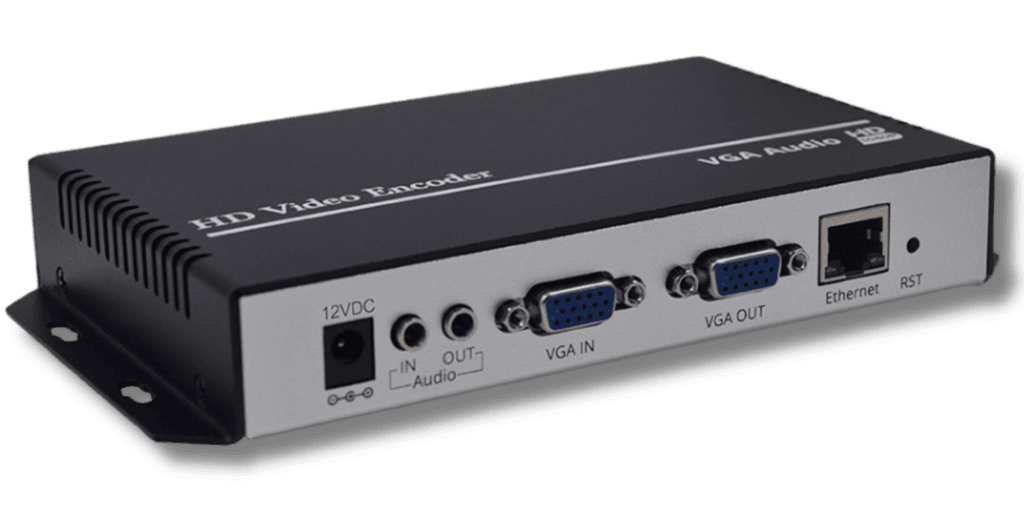
BLANKOM VDE-265 converts VGA video and separate analog stereo audio into H.265/H.264 IP streams. Four independently configured streams and VGA/audio loop-through support legacy computer integration.
Ordering Guide
- VDE-265: specify VGA timing, audio source, codecs and destination protocols
Technical Overview
The VGA input accepts computer and VESA timings up to 1920 × 1200 at 60 Hz. VGA carries video only: audio must enter through the separate 3.5 mm stereo line input. Loop-through connections keep a local display and audio path available.
One main stream and three substreams allow different delivery profiles from the same source. The main stream supports the full input resolution; substreams are limited to 1280 × 720. Codec, bitrate and frame rate should be selected for the destination decoder and network.
The Gigabit Ethernet interface carries streaming and browser management. UDP/RTP multicast suits a managed local distribution network, while RTMP/RTMPS or SRT can connect compatible remote systems. Available protocols do not guarantee that every platform accepts every codec combination.
At a Glance
INPUT
- Video input: 1 × VGA, 15-pin D-sub; up to 1920 × 1200p60
- Audio input: 3.5 mm analog stereo line input; separate from VGA
OUTPUT
- Local outputs: VGA video and analog stereo loop-through
- IP streams: 4 per input: 1 main + 3 substreams; substreams up to 1280 × 720
- Stream protocols: HTTP, HLS, FLV, RTSP, RTMP, RTMPS, UDP/RTP, SRT; unicast/multicast; ONVIF
FEATURES
- Video codecs: H.265/HEVC or H.264/AVC per stream
- Video rate control: 0.1–32 Mbps; 5–60 fps; CBR/VBR
- Audio encoding: AAC/AAC+/AAC++, MP3, MP2, AC-3, G.711; 12–640 kbps
- Network and control: RJ45 Gigabit Ethernet; Web GUI; firmware upgrades
- Overlay: Logo/text on main and second stream
Ordering Guide
- Ordering: VDE-265: specify VGA timing, audio source, codecs and destination protocols
Key Features
- Video codecs: H.265/HEVC or H.264/AVC per stream
- Video rate control: 0.1–32 Mbps; 5–60 fps; CBR/VBR
- Audio encoding: AAC/AAC+/AAC++, MP3, MP2, AC-3, G.711; 12–640 kbps
- Network and control: RJ45 Gigabit Ethernet; Web GUI; firmware upgrades
- Overlay: Logo/text on main and second stream
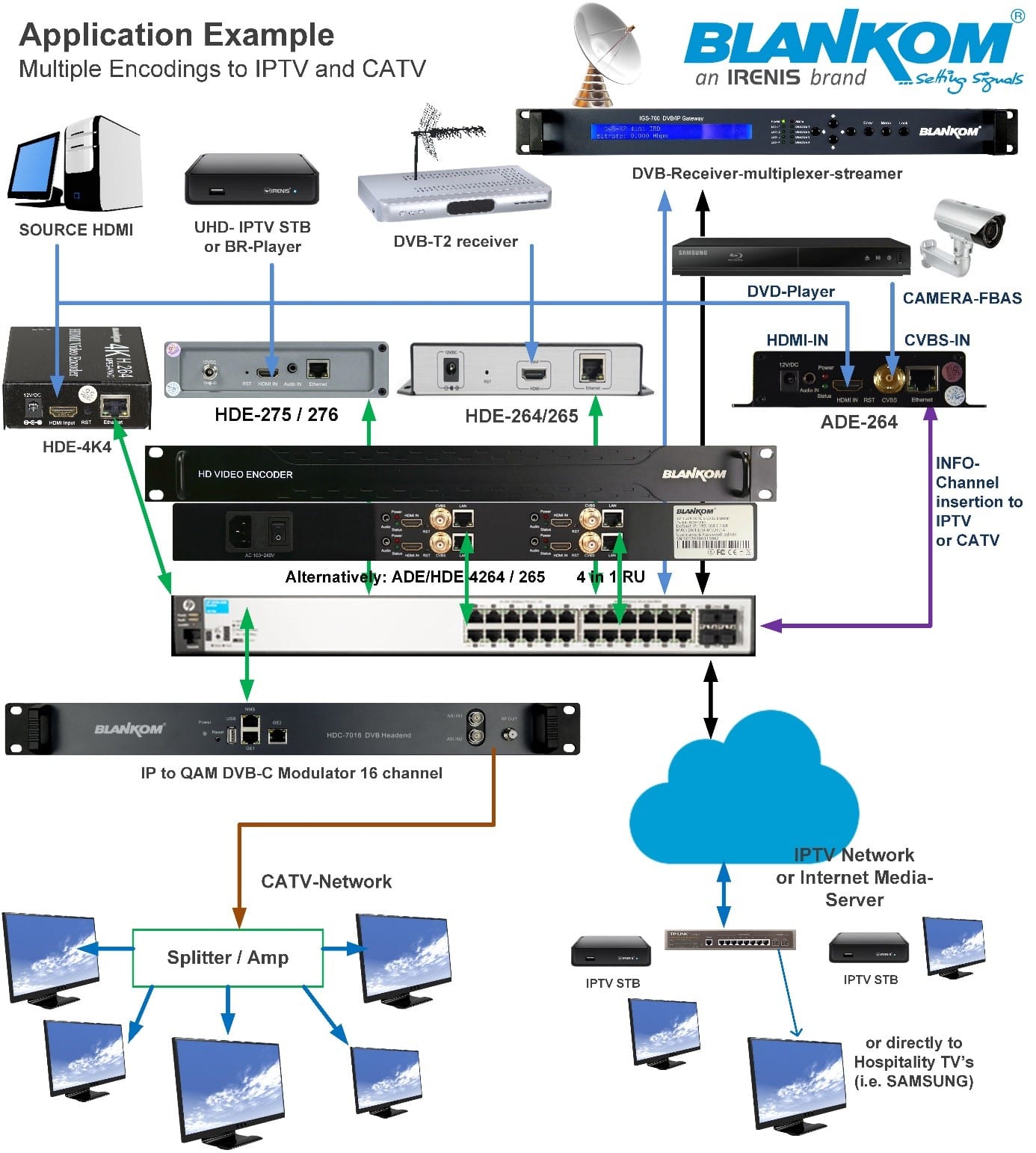
System Diagram
Manufacturer reference diagram. The complete topology and required accessories depend on the project.
Typical Applications
Legacy control-room displays
Capture the VGA output of a control PC and distribute a view to compatible IP decoders. Keep the original local monitor on the VGA loop-through. Check the actual PC output timing before commissioning.
Training and presentation distribution
Use the main stream for a larger display and a lower-resolution substream for a bandwidth-limited destination. Feed speech or presentation audio through the separate line input.
Remote technical observation
Transport a computer screen to a compatible remote receiver using SRT or another agreed protocol. Size the network for the sum of active streams and the transport overhead.
Product Images
Family reference illustration; the depicted housing or model may differ from the selected variant.
Technical Specifications
| Parameter | Specification |
|---|---|
| Video input | 1 × VGA, 15-pin D-sub; up to 1920 × 1200p60 |
| Audio input | 3.5 mm analog stereo line input; separate from VGA |
| Local outputs | VGA video and analog stereo loop-through |
| IP streams | 4 per input: 1 main + 3 substreams; substreams up to 1280 × 720 |
| Video codecs | H.265/HEVC or H.264/AVC per stream |
| Video rate control | 0.1–32 Mbps; 5–60 fps; CBR/VBR |
| Stream protocols | HTTP, HLS, FLV, RTSP, RTMP, RTMPS, UDP/RTP, SRT; unicast/multicast; ONVIF |
| Audio encoding | AAC/AAC+/AAC++, MP3, MP2, AC-3, G.711; 12–640 kbps |
| Network and control | RJ45 Gigabit Ethernet; Web GUI; firmware upgrades |
| Overlay | Logo/text on main and second stream |
| Power | 12 V DC, 1 A; published consumption 12 W |
| Enclosure | 185 × 110 × 30 mm; 300 g |
| Ordering | VDE-265: specify VGA timing, audio source, codecs and destination protocols |
The listed values follow the official technical reference. Select the required model and configuration before ordering.
Technical FAQ
1. Does VGA also carry audio?
Video input: 1 × VGA, 15-pin D-sub; up to 1920 × 1200p60. Audio input: 3.5 mm analog stereo line input; separate from VGA.
2. How many IP streams are available?
IP streams: 4 per input: 1 main + 3 substreams; substreams up to 1280 × 720.
3. What is the maximum VGA format?
Video input: 1 × VGA, 15-pin D-sub; up to 1920 × 1200p60. IP streams: 4 per input: 1 main + 3 substreams; substreams up to 1280 × 720.
4. Can the codecs differ between streams?
Video codecs: H.265/HEVC or H.264/AVC per stream.
5. Can a local monitor remain connected?
Local outputs: VGA video and analog stereo loop-through.
6. How is bandwidth adjusted?
Video rate control: 0.1–32 Mbps; 5–60 fps; CBR/VBR.
7. Which remote streaming protocols are listed?
Stream protocols: HTTP, HLS, FLV, RTSP, RTMP, RTMPS, UDP/RTP, SRT; unicast/multicast; ONVIF.
8. Which audio formats are supported?
Audio encoding: AAC/AAC+/AAC++, MP3, MP2, AC-3, G.711; 12–640 kbps.
9. How are the encoder and overlays managed?
Network and control: RJ45 Gigabit Ethernet; Web GUI; firmware upgrades. Overlay: Logo/text on main and second stream.
10. What must be specified when ordering?
Power: 12 V DC, 1 A; published consumption 12 W. Enclosure: 185 × 110 × 30 mm; 300 g. Ordering: VDE-265: specify VGA timing, audio source, codecs and destination protocols.