

 HDMI Encoder, Multiplexer and DVB Modulator
 HDMI Encoder, Multiplexer and DVB Modulator
HDM-9400
BLANKOM HDM-9400 combines 8/16/24 HDMI inputs, transport-stream multiplexing and RF modulation in one 1U chassis. Encoded local sources and incoming IP services can be organized into television multiplexes.

Ordering Guide
- Specify HDMI count, RF standard and carrier count, required codecs, IP ingest/output and ASI options
Technical Overview
HDMI encoding, service multiplexing and RF modulation are separate stages. Input resolution does not equal encoded output resolution: the H.264 specification accepts 1080p50/60 but lists 1080p25/30 as encoded output. Select the television standard and receiver codec support together.
The 9400 family adds ASI remultiplexing and a USB player input alongside HDMI and IP ingest. C/T/I/A model suffixes select DVB-C, DVB-T, ISDB-T or ATSC; they do not indicate a software-selectable universal RF output in every unit. Higher carrier-count options and HEVC variants must be explicitly confirmed rather than assumed for the standard models.
Multiplex planning must keep the sum of video, audio and signalling below the usable capacity of each RF carrier. PID remapping and PSI/SI generation organize the services, while IP mirror outputs allow compatible network distribution. Plan the RF level and cable losses for the installed network.
At a Glance
INPUT
- Physical inputs: 8/16/24 × HDMI; 1 ASI + 1 USB player input
- IP ingest: 128 transport-stream inputs via GE; UDP/RTP and supported SPTS protocols
OUTPUT
- Encoded output formats: 1080p25/30, 720p25/30, 576p25, 480p30
- RF capacity: 12 DVB-C / 8 DVB-T; ATSC/ISDB-T versions available
- IP output: MPTS mirror output over UDP/RTP/RTSP; SPTS output protocols listed in official reference; optional ASI mirror
FEATURES
- Baseline video encoding: MPEG-4 AVC/H.264; 1–13 Mbps per channel; CBR/VBR
- Audio: MPEG-1 Layer II, LC-AAC, HE-AAC; AC-3 pass-through; 48 kHz, 24-bit
- Multiplex functions: PID remapping, automatic PCR adjustment, PSI/SI generation
- Management and chassis: Web NMS, English interface, Ethernet firmware upgrade; 482 × 328 × 44 mm
Ordering Guide
- Ordering: Specify HDMI count, RF standard and carrier count, required codecs, IP ingest/output and ASI options
Key Features
- Baseline video encoding: MPEG-4 AVC/H.264; 1–13 Mbps per channel; CBR/VBR
- Audio: MPEG-1 Layer II, LC-AAC, HE-AAC; AC-3 pass-through; 48 kHz, 24-bit
- Multiplex functions: PID remapping, automatic PCR adjustment, PSI/SI generation
- Management and chassis: Web NMS, English interface, Ethernet firmware upgrade; 482 × 328 × 44 mm
System Diagram
Manufacturer reference diagram. The complete topology and required accessories depend on the project.
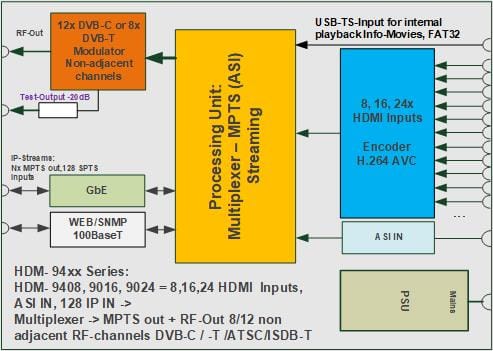
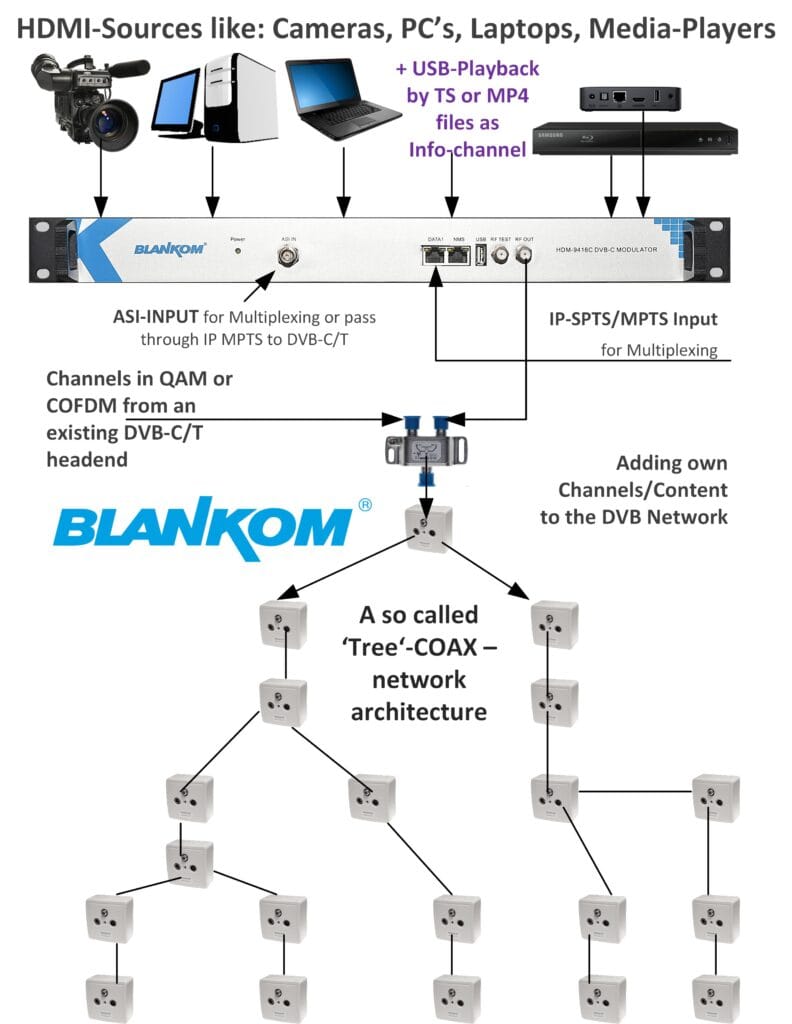
Typical Applications
Hotel television headend
Encode local HDMI sources, combine selected IP services and distribute them to compatible televisions over the existing coax network. Select DVB-C or DVB-T according to the installed TV tuners.
Campus and institutional TV
Place institutional information and programme sources into planned multiplexes. Check the combined audio/video bitrate against each carrier capacity and reserve bandwidth for signalling.
Hybrid RF and IP distribution
Use RF for television receivers and compatible MPTS mirror streams for IP equipment. RF output level and Ethernet traffic require separate distribution calculations.
Model Comparison
| Model | Configuration |
|---|---|
| HDM-9408C | 8 HDMI / DVB-C, 12 RF |
| HDM-9408T | 8 HDMI / DVB-T, 8 RF |
| HDM-9408I | 8 HDMI / ISDB-T |
| HDM-9408A | 8 HDMI / ATSC |
| HDM-9416C | 16 HDMI / DVB-C, 12 RF |
| HDM-9416T | 16 HDMI / DVB-T, 8 RF |
| HDM-9416I | 16 HDMI / ISDB-T |
| HDM-9416A | 16 HDMI / ATSC |
| HDM-9424C | 24 HDMI / DVB-C, 12 RF |
| HDM-9424T | 24 HDMI / DVB-T, 8 RF |
| HDM-9424I | 24 HDMI / ISDB-T |
| HDM-9424A | 24 HDMI / ATSC |
Product Images
Family reference illustration; the depicted housing or model may differ from the selected variant.
Technical Specifications
| Parameter | Specification |
|---|---|
| Physical inputs | 8/16/24 × HDMI; 1 ASI + 1 USB player input |
| IP ingest | 128 transport-stream inputs via GE; UDP/RTP and supported SPTS protocols |
| Baseline video encoding | MPEG-4 AVC/H.264; 1–13 Mbps per channel; CBR/VBR |
| Input formats | 1080p50/60, 1080i50/60, 720p50/60, 576i50, 480i60 |
| Encoded output formats | 1080p25/30, 720p25/30, 576p25, 480p30 |
| Audio | MPEG-1 Layer II, LC-AAC, HE-AAC; AC-3 pass-through; 48 kHz, 24-bit |
| Multiplex functions | PID remapping, automatic PCR adjustment, PSI/SI generation |
| RF capacity | 12 DVB-C / 8 DVB-T; ATSC/ISDB-T versions available |
| DVB-C profile | EN 300 429 / ITU-T J.83 A/B; Annex A 16/32/64/128/256 QAM; Annex B 64/256 QAM; 5–7 MSps |
| DVB-T profile | EN 300 744; 2K/4K/8K FFT as listed in the technical reference |
| RF tuning | 50–960 MHz; 1 kHz steps |
| IP output | MPTS mirror output over UDP/RTP/RTSP; SPTS output protocols listed in official reference; optional ASI mirror |
| Management and chassis | Web NMS, English interface, Ethernet firmware upgrade; 482 × 328 × 44 mm |
| Power and environment | AC 110 V ±10% or 220 V ±10%, 50/60 Hz; operation 0–45 °C |
| Ordering | Specify HDMI count, RF standard and carrier count, required codecs, IP ingest/output and ASI options |
The listed values follow the official technical reference. Select the required model and configuration before ordering.
Technical FAQ
1. How many HDMI sources can be connected?
Physical inputs: 8/16/24 × HDMI; 1 ASI + 1 USB player input.
2. Can external IP programmes be added?
IP ingest: 128 transport-stream inputs via GE; UDP/RTP and supported SPTS protocols. Multiplex functions: PID remapping, automatic PCR adjustment, PSI/SI generation.
3. Does 1080p60 input mean 1080p60 encoding output?
Input formats: 1080p50/60, 1080i50/60, 720p50/60, 576i50, 480i60. Encoded output formats: 1080p25/30, 720p25/30, 576p25, 480p30.
4. Which codec and bitrate are the confirmed baseline?
Baseline video encoding: MPEG-4 AVC/H.264; 1–13 Mbps per channel; CBR/VBR.
5. Which audio options are supported?
Audio: MPEG-1 Layer II, LC-AAC, HE-AAC; AC-3 pass-through; 48 kHz, 24-bit.
6. How many RF carriers are specified?
RF capacity: 12 DVB-C / 8 DVB-T; ATSC/ISDB-T versions available.
7. How do DVB-C and DVB-T profiles differ?
DVB-C profile: EN 300 429 / ITU-T J.83 A/B; Annex A 16/32/64/128/256 QAM; Annex B 64/256 QAM; 5–7 MSps. DVB-T profile: EN 300 744; 2K/4K/8K FFT as listed in the technical reference.
8. What is the tuning range?
RF tuning: 50–960 MHz; 1 kHz steps.
9. Can the output also be used over IP?
IP output: MPTS mirror output over UDP/RTP/RTSP; SPTS output protocols listed in official reference; optional ASI mirror.
10. What must be fixed in the ordering configuration?
Management and chassis: Web NMS, English interface, Ethernet firmware upgrade; 482 × 328 × 44 mm. Power and environment: AC 110 V ±10% or 220 V ±10%, 50/60 Hz; operation 0–45 °C. Ordering: Specify HDMI count, RF standard and carrier count, required codecs, IP ingest/output and ASI options.