

 IP Gateway and Stream Protocol Converter
 IP Gateway and Stream Protocol Converter
BIG-1050X/BIG-1100X
BLANKOM BIG-1050X/BIG-1100X bridge IP streaming protocols without video or audio re-encoding. UDP/RTP and SRT conversion, stream monitoring and configuration-dependent capacity support IPTV and broadcast contribution networks.


Ordering Guide
- RTSP, HLS, RTMP, HTTP-FLV; specify when ordering
- CBR shaping not confirmed; CBR pass-through, 204-byte TS, SMPTE 2022-7, SRT version and redundant PSU require written confirmation
Technical Overview
The gateway changes transport protocols rather than video resolution, codec or audio format. Standard input protocols are broader than standard outputs: RTSP, HLS, RTMP and HTTP-FLV output are ordering options, while UDP/RTP and SRT are the standard output baseline.
Published 50/100-channel capacities apply to streams below 4 Mbps per channel. Actual capacity depends on bitrate, protocol, encryption, retransmission load, network bandwidth and the supplied hardware/licence configuration. Ethernet port count and line rate are not an aggregate SRT processing guarantee.
SRT Caller, Listener and Rendezvous modes, AES encryption and stream statistics support contribution engineering. IPv6 and FEC are not supported in the current published implementation. CBR shaping, 204-byte TS, SMPTE 2022-7 and redundant power must not be assumed; requirements need configuration-specific written confirmation.
At a Glance
INPUT
- Standard inputs: UDP unicast/multicast, RTP, SRT, HTTP/HLS, RTMP, RTSP
OUTPUT
- Standard outputs: UDP unicast/multicast, RTP, SRT
FEATURES
- SRT functions: Caller, Listener, Rendezvous; AES-128/256; configurable latency and retransmission
- Network functions: IPv4, IEEE 802.1Q VLAN, IGMP v2/v3; IPv6 and FEC not supported
- Monitoring: TR 101 290, PSI/SI checking; bitrate, packet loss, SRT retransmissions, RTT and latency statistics
- Management: Web GUI, HTTPS, user privileges, SNMP v2/v3
Ordering Guide
- Optional outputs: RTSP, HLS, RTMP, HTTP-FLV; specify when ordering
- Configuration limits: CBR shaping not confirmed; CBR pass-through, 204-byte TS, SMPTE 2022-7, SRT version and redundant PSU require written confirmation
Key Features
- SRT functions: Caller, Listener, Rendezvous; AES-128/256; configurable latency and retransmission
- Network functions: IPv4, IEEE 802.1Q VLAN, IGMP v2/v3; IPv6 and FEC not supported
- Monitoring: TR 101 290, PSI/SI checking; bitrate, packet loss, SRT retransmissions, RTT and latency statistics
- Management: Web GUI, HTTPS, user privileges, SNMP v2/v3
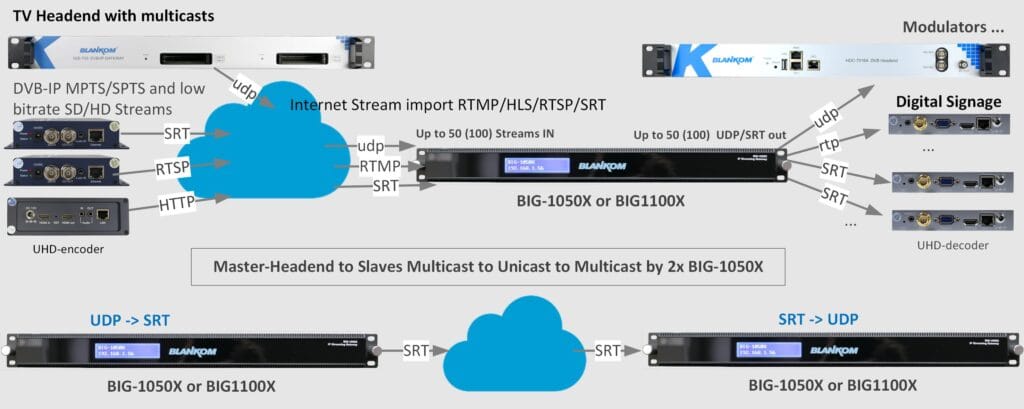
System Diagram
Manufacturer reference diagram. The complete topology and required accessories depend on the project.
Typical Applications
UDP/RTP to SRT contribution
Take a local encoder transport stream into SRT for a compatible remote site. Confirm bitrate, encryption, loss pattern and latency budget before sizing the channel licence.
SRT to local multicast
Receive a WAN SRT feed and deliver UDP/RTP to a managed headend LAN. The downstream decoder must accept the original codec because the gateway does not re-encode it.
Protocol normalization and monitoring
Bring different supported inputs into an agreed output protocol while observing transport health. Optional streaming outputs and hardware extensions must be listed in the supplied configuration.
Model Comparison
| Model | Configuration |
|---|---|
| BIG-1050X | 50 channels below 4 Mbps; 6 × GbE; 483 × 244 × 44 mm; max. 60 W |
| BIG-1100X | 100 channels below 4 Mbps; 8 × GbE; 483 × 505 × 44 mm; max. 450 W |
Product Images
Family reference illustration; the depicted housing or model may differ from the selected variant.
Technical Specifications
| Parameter | Specification |
|---|---|
| Standard inputs | UDP unicast/multicast, RTP, SRT, HTTP/HLS, RTMP, RTSP |
| Standard outputs | UDP unicast/multicast, RTP, SRT |
| Optional outputs | RTSP, HLS, RTMP, HTTP-FLV; specify when ordering |
| Published capacity | BIG-1050X: up to 50; BIG-1100X: up to 100 channels, each below 4 Mbps; actual workload must be confirmed |
| Ethernet ports | BIG-1050X: 6 × Gigabit RJ45; BIG-1100X: 8 × Gigabit RJ45; management shares a data interface |
| SRT functions | Caller, Listener, Rendezvous; AES-128/256; configurable latency and retransmission |
| Network functions | IPv4, IEEE 802.1Q VLAN, IGMP v2/v3; IPv6 and FEC not supported |
| Monitoring | TR 101 290, PSI/SI checking; bitrate, packet loss, SRT retransmissions, RTT and latency statistics |
| Management | Web GUI, HTTPS, user privileges, SNMP v2/v3 |
| BIG-1050X hardware | 1U; 483 × 244 × 44 mm; 3.5 kg; maximum 60 W |
| BIG-1100X hardware | 1U; 483 × 505 × 44 mm; 8.5 kg; maximum 450 W |
| Power and temperature | AC 100–240 V; operation 5–45 °C; storage −10–65 °C |
| Configuration limits | CBR shaping not confirmed; CBR pass-through, 204-byte TS, SMPTE 2022-7, SRT version and redundant PSU require written confirmation |
The listed values follow the official technical reference. Select the required model and configuration before ordering.
Technical FAQ
1. Does the gateway transcode video?
No. It converts transport protocols without re-encoding video or audio. The destination must support the original codec.
2. Which outputs are standard?
Standard outputs: UDP unicast/multicast, RTP, SRT. Optional outputs: RTSP, HLS, RTMP, HTTP-FLV; specify when ordering.
3. How should the 50/100-channel capacity be interpreted?
Published capacity: BIG-1050X: up to 50; BIG-1100X: up to 100 channels, each below 4 Mbps; actual workload must be confirmed.
4. How many network ports are provided?
Ethernet ports: BIG-1050X: 6 × Gigabit RJ45; BIG-1100X: 8 × Gigabit RJ45; management shares a data interface.
5. Which SRT modes and encryption are supported?
SRT functions: Caller, Listener, Rendezvous; AES-128/256; configurable latency and retransmission.
6. Are IPv6 and FEC supported?
Network functions: IPv4, IEEE 802.1Q VLAN, IGMP v2/v3; IPv6 and FEC not supported.
7. Which diagnostics are available?
Monitoring: TR 101 290, PSI/SI checking; bitrate, packet loss, SRT retransmissions, RTT and latency statistics.
8. Can SNMP and HTTPS be used?
Management: Web GUI, HTTPS, user privileges, SNMP v2/v3.
9. What are the chassis and power differences?
BIG-1050X hardware: 1U; 483 × 244 × 44 mm; 3.5 kg; maximum 60 W. BIG-1100X hardware: 1U; 483 × 505 × 44 mm; 8.5 kg; maximum 450 W. Power and temperature: AC 100–240 V; operation 5–45 °C; storage −10–65 °C.
10. Are hitless switching and redundant power guaranteed?
Configuration limits: CBR shaping not confirmed; CBR pass-through, 204-byte TS, SMPTE 2022-7, SRT version and redundant PSU require written confirmation.