

 G.hn Ethernet over Coax Master Controller
 G.hn Ethernet over Coax Master Controller
BEM-101/102
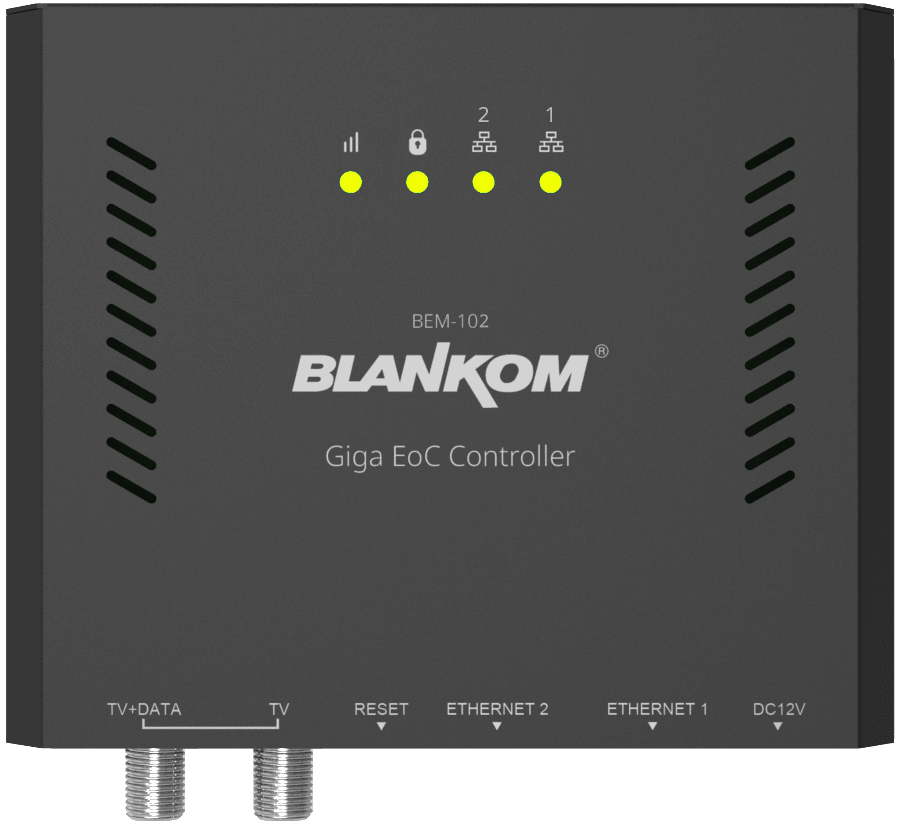
BLANKOM BEM-101/BEM-102 are master controllers for a G.hn Ethernet over Coax network. BEM-101 serves up to 16 receivers with one Ethernet port; BEM-102 serves up to 32 with two Ethernet ports.
Ordering Guide
- Choose BEM-101/102 according to receiver count, traffic and power budget
- Specify coax topology, attenuation, receiver count, LAN ports, TV services and power demand
Technical Overview
The system reuses a compatible coaxial distribution network for Ethernet services. It consists of a BEM master and BES receivers or a BEW receiver/access point. Existing splitters, taps and amplifiers must pass the required EoC band in both directions. A cable-plant survey is therefore part of selecting the equipment.
Published G.hn rates describe link or system capacity, not a guaranteed application rate for every room or Ethernet port. Shared coax capacity, attenuation, splitters, concurrent users and uplink bandwidth affect usable throughput. Plan the total service demand rather than adding the nominal speeds of all receiver ports.
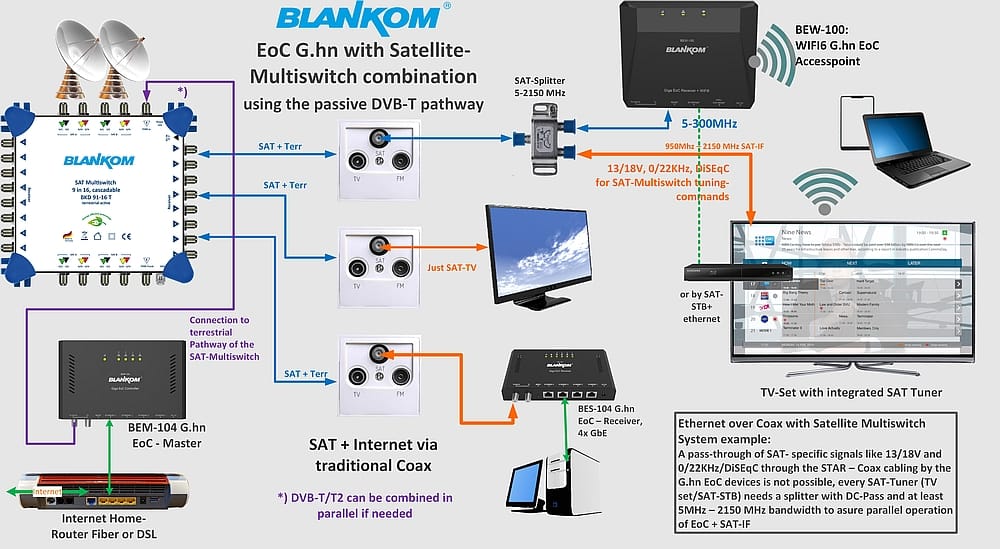
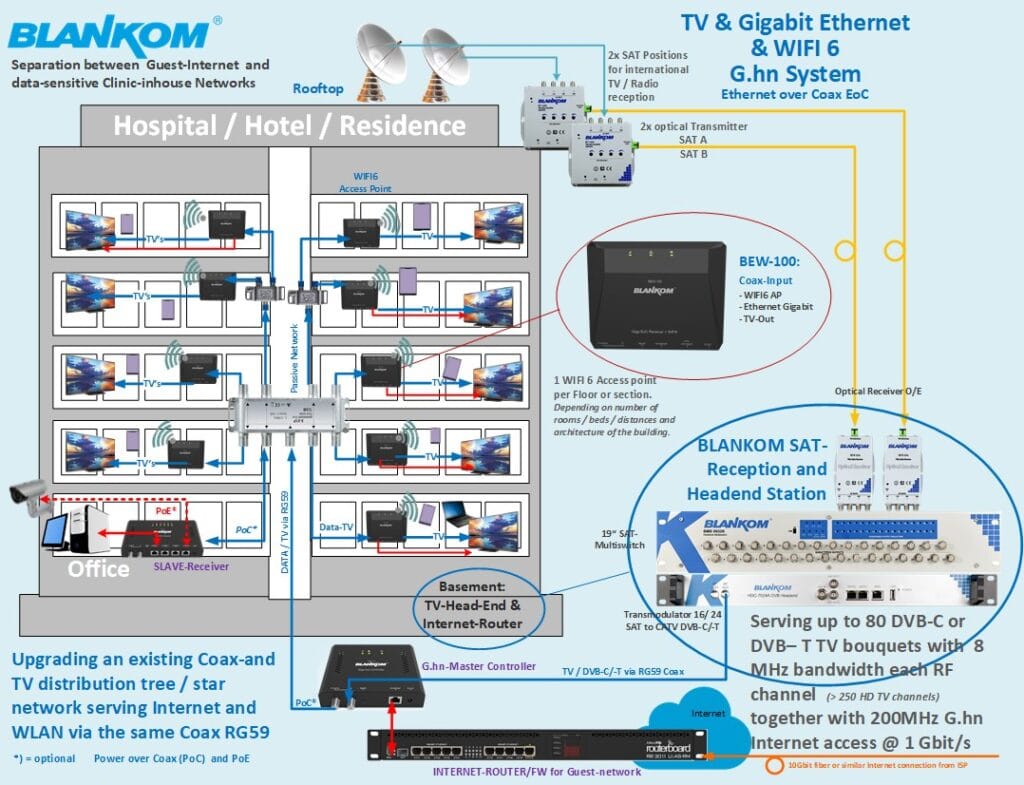
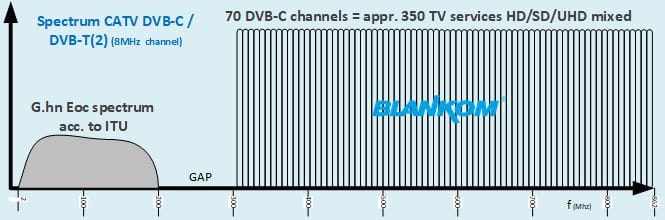
TV and data use separate frequency ranges in a planned network. The official examples show satellite multiswitch, residential and hospitality installations. Power features are product-specific: PoE/PoC on BEM/BES must not be assumed for BEW-100, which uses an external 12 V supply and has no PoE support.
At a Glance
INPUT
- System role: BEM-101 master for up to 16 receivers; BEM-102 for up to 32
- Connectors: 75 Ω F-female TV/EoC; RJ45 LAN
OUTPUT
- Ethernet ports: BEM-101: 1; BEM-102: 2; 10/100/1000 Mbps
FEATURES
- TV coexistence: BEM/BES reference: TV 300–862 MHz; verify filtering for the installed system
- Power: PoC and PoE support; confirm supplied configuration and total power budget
- Wireless function: Controller; integrated Wi-Fi not listed
- Installation: Compatible two-way coax paths required; GRPF-200 return-path filter optional; assess amplifiers and taps
Ordering Guide
- Model selection: Choose BEM-101/102 according to receiver count, traffic and power budget
- Engineering survey: Specify coax topology, attenuation, receiver count, LAN ports, TV services and power demand
Key Features
- TV coexistence: BEM/BES reference: TV 300–862 MHz; verify filtering for the installed system
- Power: PoC and PoE support; confirm supplied configuration and total power budget
- Wireless function: Controller; integrated Wi-Fi not listed
- Installation: Compatible two-way coax paths required; GRPF-200 return-path filter optional; assess amplifiers and taps
System Diagram
Manufacturer reference diagram. The complete topology and required accessories depend on the project.
Typical Applications
Hotel room network retrofit
Reuse suitable coax cabling with a master and room receivers. Check splitter paths, shared capacity and power delivery before fixing receiver count. IPTV and guest Internet remain services of the connected network equipment.
Residential and building services
Carry Ethernet over compatible television cabling while preserving the planned TV band. Select bidirectional distribution components and filtering for the real topology; do not assume every TV amplifier passes the data band.
Wired and wireless network endpoints
Choose BES for the required number of wired ports or BEW-100 where an integrated Wi-Fi 6 access point is required. The EoC system transports Ethernet; connected decoders determine video codec support.
Model Comparison
| Model | Configuration |
|---|---|
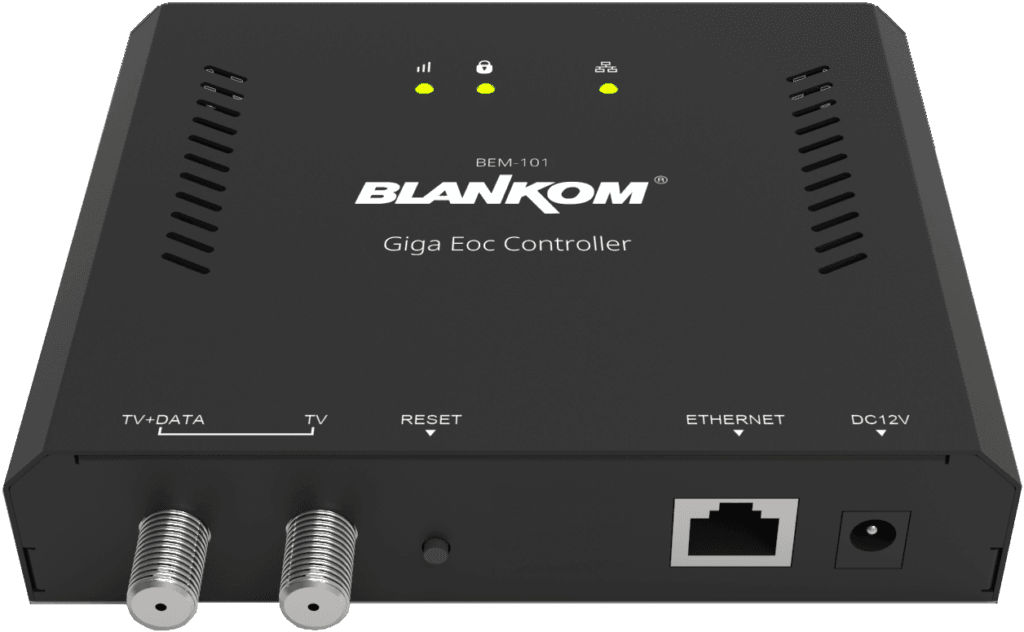
| BEM-101 | 1 LAN; up to 16 receivers |
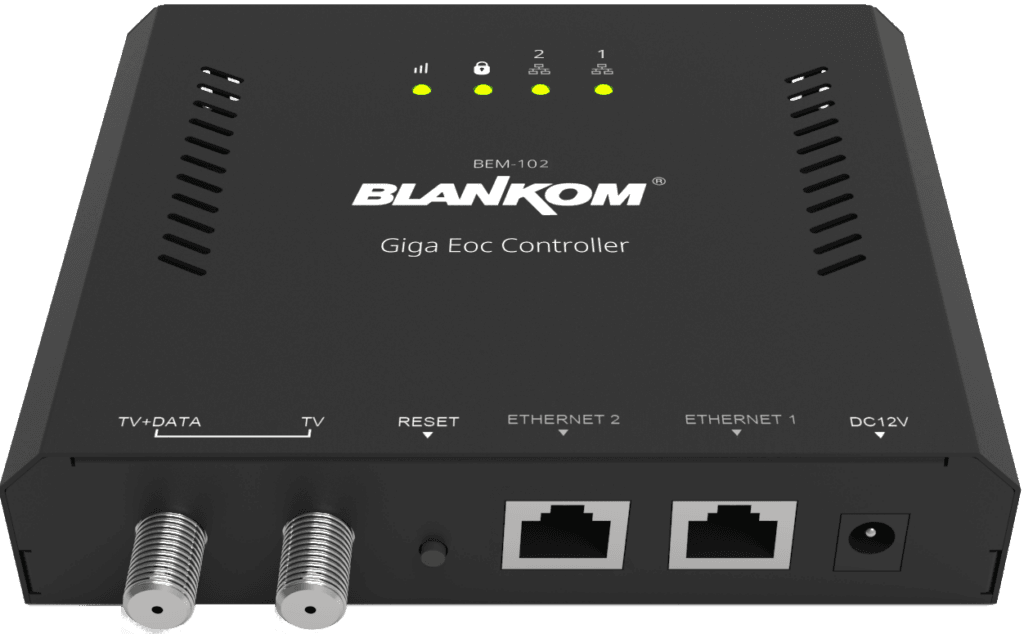
| BEM-102 | 2 LAN; up to 32 receivers |
Product Images
Family reference illustration; the depicted housing or model may differ from the selected variant.
Technical Specifications
| Parameter | Specification |
|---|---|
| System role | BEM-101 master for up to 16 receivers; BEM-102 for up to 32 |
| Ethernet ports | BEM-101: 1; BEM-102: 2; 10/100/1000 Mbps |
| Published rate | System throughput up to 1.2 Gbps; shared, not guaranteed per receiver |
| EoC band | 5–200 MHz |
| TV coexistence | BEM/BES reference: TV 300–862 MHz; verify filtering for the installed system |
| Connectors | 75 Ω F-female TV/EoC; RJ45 LAN |
| Power | PoC and PoE support; confirm supplied configuration and total power budget |
| Wireless function | Controller; integrated Wi-Fi not listed |
| Installation | Compatible two-way coax paths required; GRPF-200 return-path filter optional; assess amplifiers and taps |
| Environment | Operation 0–40 °C, 10–95% RH non-condensing; storage −10–70 °C |
| Model selection | Choose BEM-101/102 according to receiver count, traffic and power budget |
| Engineering survey | Specify coax topology, attenuation, receiver count, LAN ports, TV services and power demand |
The listed values follow the official technical reference. Select the required model and configuration before ordering.
Technical FAQ
1. What is the role of this product in an EoC system?
System role: BEM-101 master for up to 16 receivers; BEM-102 for up to 32.
2. How many Ethernet ports are available?
Ethernet ports: BEM-101: 1; BEM-102: 2; 10/100/1000 Mbps.
3. Is the published rate guaranteed for every receiver?
Published rate: System throughput up to 1.2 Gbps; shared, not guaranteed per receiver.
4. Which coax frequency bands are used?
EoC band: 5–200 MHz. TV coexistence: BEM/BES reference: TV 300–862 MHz; verify filtering for the installed system.
5. Which physical connectors are used?
Connectors: 75 Ω F-female TV/EoC; RJ45 LAN.
6. How is the unit powered, and does it support PoE?
Power: PoC and PoE support; confirm supplied configuration and total power budget.
7. Does the model include Wi-Fi?
Wireless function: Controller; integrated Wi-Fi not listed.
8. Can existing TV splitters and amplifiers be reused?
Installation: Compatible two-way coax paths required; GRPF-200 return-path filter optional; assess amplifiers and taps.
9. What operating environment is specified?
Environment: Operation 0–40 °C, 10–95% RH non-condensing; storage −10–70 °C.
10. What is needed for model selection?
Model selection: Choose BEM-101/102 according to receiver count, traffic and power budget. Engineering survey: Specify coax topology, attenuation, receiver count, LAN ports, TV services and power demand.