12-input SDI encoder and DVB-C modulator
HDM-12220C


Ordering Guide
BLANKOM HDM-12220C
Specify HDM-12220C for twelve SDI inputs and DVB-C output. Specify the tuner option and whether AC-3 stereo encoding is required.
At a Glance
Front and Rear Panels

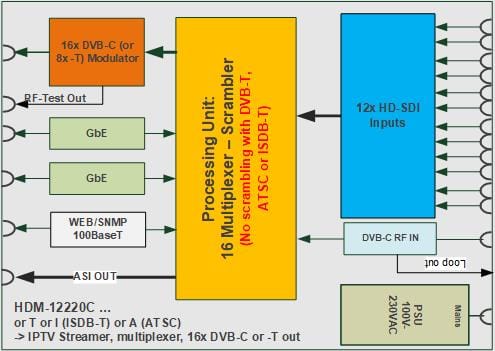
System Diagram
Technical Overview
DATA1 accepts UDP/RTP transport streams. The multiplexer combines selected IP services, locally encoded SDI programmes and services from the tuner. DATA2 distributes the resulting MPTS alongside the RF output.
Typical Applications
RF distribution
Feed digital cable headends with local studio or event channels. Choose DVB-C-compatible receivers for the 16 carrier outputs.
Hybrid RF/IP headend
Use DATA2 to pass the same multiplexes to an IPTV distribution stage. Monitor or forward a single multiplex at the ASI output.
Model Comparison
| Model | Configuration |
|---|---|
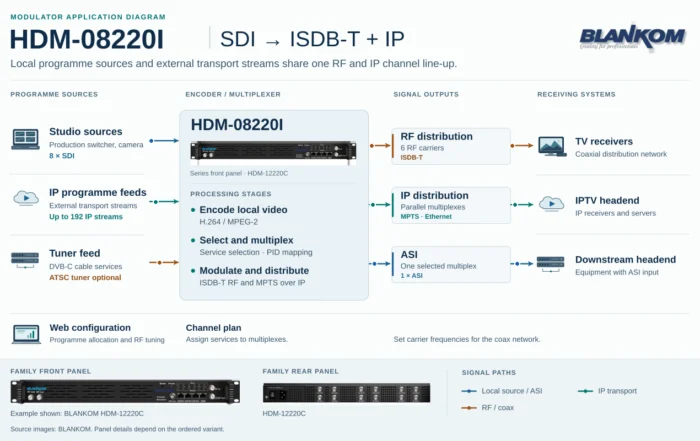
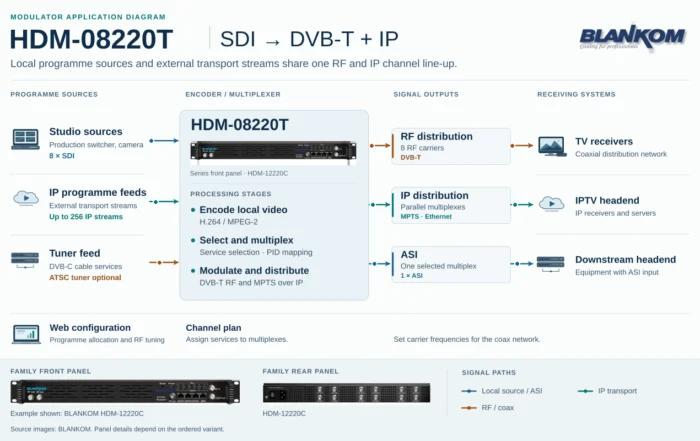
| HDM-12220A | 8 × ATSC |
| HDM-12220C | 16 × DVB-C |
| HDM-12220I | 6 × ISDB-T |
| HDM-12220T | 8 × DVB-T |
BLANKOM HDM-12220C Application Diagram
Technical Specifications
| Reference | Value |
|---|---|
| SDI sources | 12 SDI, up to 1080p50/60 input |
| IP inputs on DATA1 | Up to 512 UDP/RTP transport streams |
| Video encoding | H.264/AVC 0.8–19 Mbit/s · MPEG-2 1–19 Mbit/s · CBR/VBR |
| Video formats | Up to 1080p25/30 or 1080i50/60 output |
| Audio | MPEG Layer II, MPEG-2/4 AAC, AC-3 pass-through. Optional AC-3 stereo encoding. |
| RF modulation | EN 300 429 / ITU-T J.83 A/B · 16 × QAM |
| Output frequency | 50–960 MHz |
| Transport stream outputs | 16 × MPTS (IP) · 1 × ASI |
| Chassis | 19″ · 1U · 482 × 440 × 44 mm |
| Operating temperature | 0–45 °C |
Specifications are subject to change without prior notice. Confirm supplied hardware, firmware and PSU configuration.
Engineering FAQ
How many streams can DATA1 receive on the HDM-12220C?
The DVB-C configuration accepts up to 512 IP input streams. Its 16 RF multiplexes are also available as 16 MPTS on DATA2.
Does the unit have a specified end-to-end delay?
Latency depends on codec, GOP structure and receiver buffering. For a live venue, verify the assembled signal path using the intended receiver.